


For two years the market rewarded the largest technology companies for how much they were prepared to spend on artificial intelligence. In the final week of October it began to ask for the cash, and shareholders felt the question first.
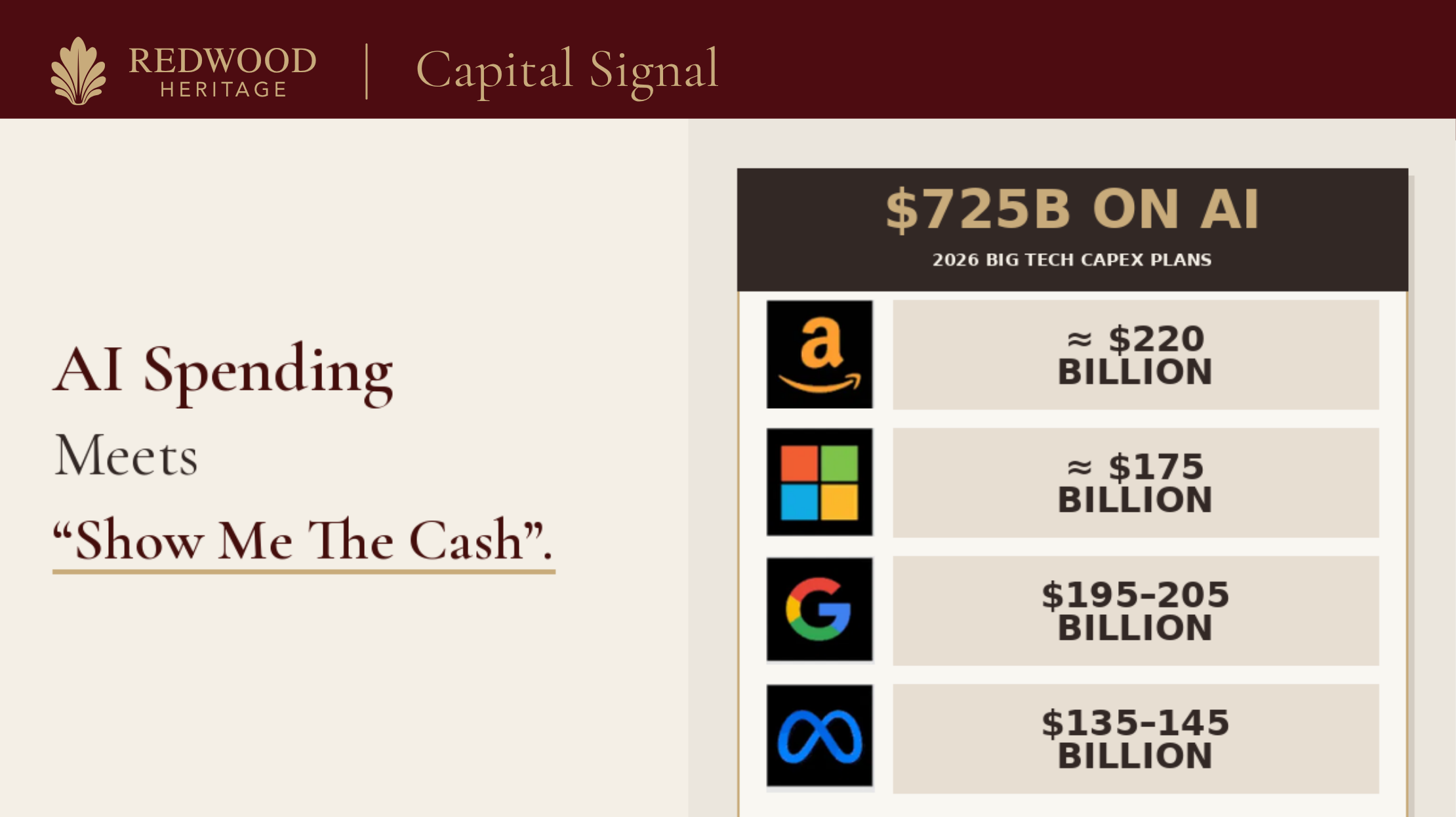
Alphabet, Amazon, Microsoft and Meta have guided to at least $725 billion of capital spending between them this year, with more planned for 2027. Alphabet’s shares fell 12.6% on 29 October, their steepest one-day fall since the company listed in 2004, removing roughly $500 billion of market value. Meta had fallen 7.8% a week earlier. Over the past twelve months Amazon has spent $42.4 billion more than its business generated, against $7.6 billion three months before. On 30 October Intel lost 28.6%, its worst session since 1974, and the S&P 500 closed a third consecutive losing week. Microsoft, whose Azure cloud grew 48%, was the clear exception.
At Redwood Heritage we read this as more than a difficult earnings season. It marks a change in what these companies are, and in what a family actually owns when it holds them. This Brief sets out the evidence and the governance questions that follow from it.
The chart below shows the change at Alphabet, where it is easiest to see. The light bars are quarterly spending on data centres, chips and servers. The dark bars are free cash flow, meaning the cash left for shareholders once that spending has been paid for. In the third quarter of 2025 the two stood level at about $24 billion each. Twelve months later spending had reached $51.4 billion and free cash flow stood at minus $9.1 billion, the second negative quarter in succession. Alphabet has also suspended its share buybacks.
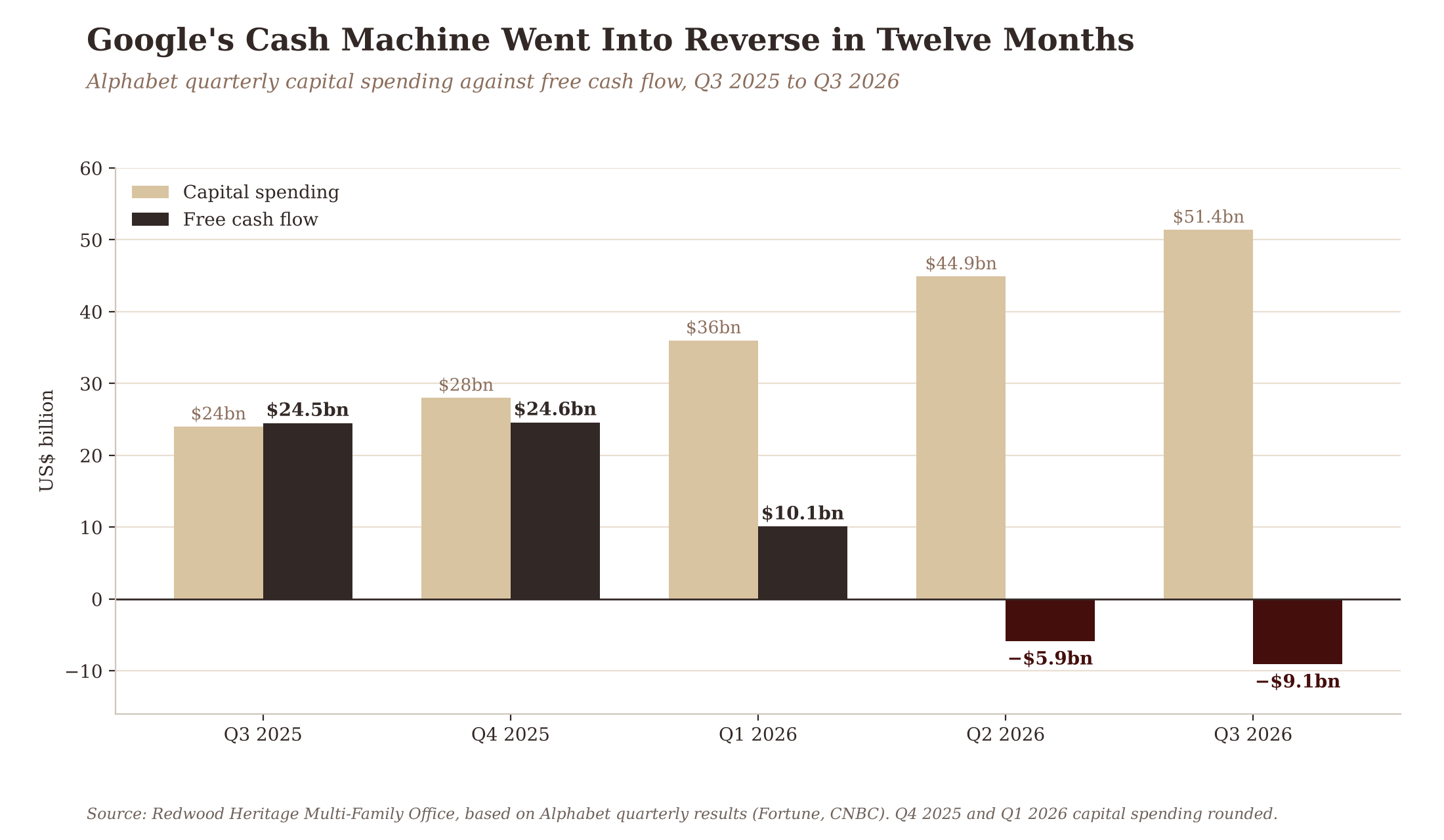
None of this describes a business in decline. Alphabet’s revenue rose 25% in the quarter and Google Cloud more than doubled to $30.7 billion. Growth in search, which funds most of the group, slowed to 12%, from 19% in the first quarter and 17% in the second. For an owner, however, the decisive figure is free cash flow, because it is the part of corporate success that can actually be paid out as a dividend, returned through a buyback or kept as financial strength. On that measure, the direction of travel has reversed.
Big Tech’s AI bill is now being sent to its shareholders.
At Least $725 Billion In Twelve Months
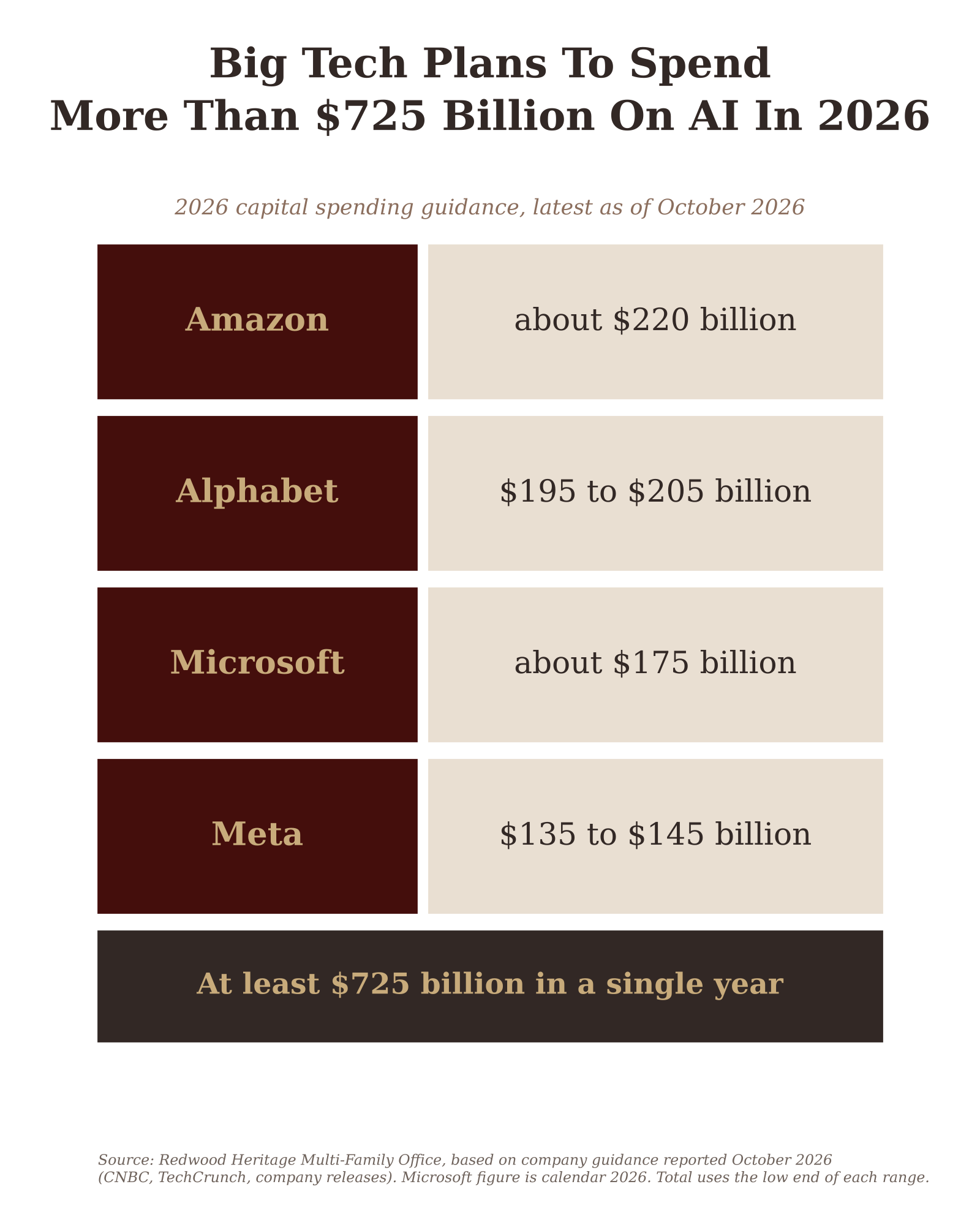
Alphabet is one of four. The card below sets out each company’s guidance for capital spending in 2026. Amazon expects about $220 billion and has said it will spend more in 2027. Alphabet has held its range of $195 billion to $205 billion and expects a significant increase next year. Microsoft points to about $175 billion for the calendar year, and Meta has narrowed its range to $135 billion to $145 billion, close to double the $72.2 billion it spent in 2025. Taking the low end of each range, the total is at least $725 billion in a single year.
The strain on cash is visible across the group. In the third quarter Meta’s capital spending of $34.9 billion exceeded the $32.8 billion of cash its operations produced, leaving free cash flow of minus $2.1 billion against plus $10.6 billion a year earlier, and it repurchased no shares. Amazon spent $75.9 billion in the quarter alone. At Microsoft, capital spending of $45.2 billion was equivalent to roughly half of quarterly revenue of $92.3 billion.
Shareholders Are Now Funding The Build-Out
Spending on this scale has to be financed, and a growing share of the financing now comes from owners. In June Alphabet raised $84.8 billion of new equity, including $10 billion from Berkshire Hathaway. Alongside its third-quarter results, Meta announced a new class of shares that carries no vote. In July we examined the borrowing that surrounds these projects in The Hidden USD 120 Billion Debt Behind AI’s Boom, much of it held away from the companies’ own balance sheets. The new development is that shareholders are now carrying part of the cost directly, through fresh equity, paused buybacks and shares without voting rights.
For long-term owners this alters the original bargain. For much of the past decade these companies combined rapid growth with modest capital needs and generous cash returns, which is precisely what made them attractive to families seeking growth without giving up flexibility. Two of those three qualities are now under review.
Cloud revenue is doubling while the cash reaching Big Tech’s owners shrinks.
The Market Is Now Paying For Cash
The chart below shows how the market judged each company once its results were known. Microsoft rose 4% in extended trading after reporting Azure growth of 48% and free cash flow of $18.6 billion. Meta fell 7.8% the day after its results, and Alphabet 12.6%. Intel, which said it does not expect positive cash flow this year and guided fourth-quarter revenue to $15 billion to $16 billion against expectations near $17 billion, fell 28.6%.
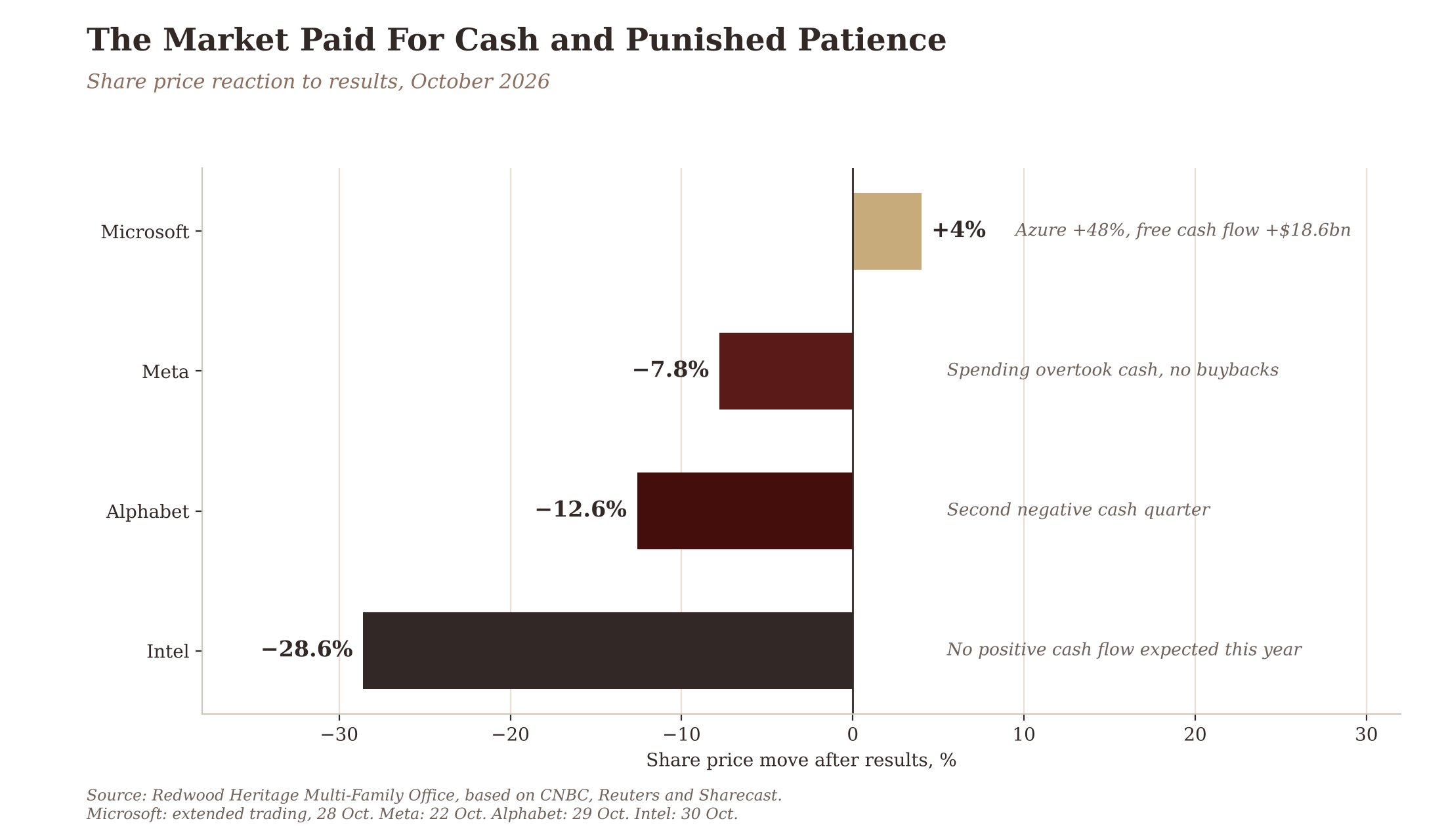
Read from the top of the chart to the bottom, the pattern is consistent: the closer a company was to showing cash from its AI investment, the better the market treated it. The returns may still arrive. Amazon expects its cloud business, which grew 39% in the third quarter, to grow by more than 40% in both 2027 and 2028, and Microsoft has guided to Azure growth of 49% to 50% in the current quarter. Our point is narrower. These companies have moved from needing little capital to building physical infrastructure on an enormous scale, and an infrastructure programme is judged by the date it begins to pay.
Many Families Hold This Exposure Without Having Chosen It
Many families own these companies through index funds and global equity mandates, in which the largest companies automatically carry the largest weights. That has been a rational way to capture a decade of growth, and it has rewarded patient owners. It also means a family’s equity portfolio may now contain one very large decision about AI spending, taken by a small number of boards in the United States.
From Dubai, where the families we work with plan across generations, our approach is to treat that exposure as a decision in its own right. In practice, that means measuring these holdings by the cash they return to their owners as well as by their growth, and setting the size of the family’s exposure to this spending cycle deliberately at the investment committee, with a clear view of how it sits beside the family’s own liquidity needs.
If the family owns the index, it owns Big Tech’s AI bet.
Conclusione
October delivered the verdict in share prices. Alphabet lost 12.6% in a single session and roughly $500 billion of value with it, Meta fell 7.8%, and Intel collapsed by 28.6%, its worst day since 1974. Microsoft, the one company that could show cash coming back from its AI spending, rose 4%. Big Tech is now spending faster than its businesses produce cash, its shareholders are funding the gap through new shares and paused buybacks, and the market will go on marking these companies down until the spending starts to pay.
For a family, the right response is two plain questions at the next investment committee. How much of our portfolio is riding on a handful of companies getting AI right? And how long are we prepared to fund them before they start paying us back?
Spending builds the future. Cash pays the family that owns it.
Il “Redwood Family Office Brief” è pubblicato da Redwood Heritage Multi-Family Office. Leggetelo con attenzione, condividetelo con una persona responsabile di un patrimonio familiare di rilievo e iscrivetevi.

