


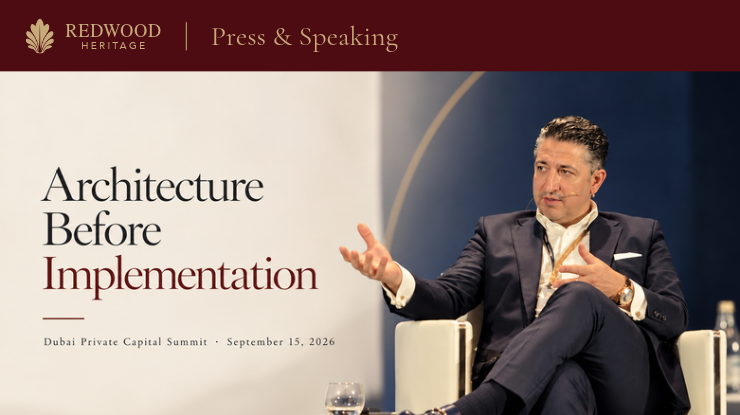
At the Dubai Private Capital Summit this month, our Founder & CEO, Ahmad Saidali, made a point that sounds obvious and is rarely practised: a family office should begin with the family. The industry often works the other way round. A manager presents a strategy, a bank proposes an allocation, a private market opportunity arrives, and capital gathers around a series of decisions that each look sensible on their own. What is often missing is the design that decides how those pieces fit together, and whether they reflect what the family is actually trying to achieve. What follows is the sequence we believe the work should take.
The family context should define the capital structure. The capital structure should shape the strategic asset allocation. The allocation should determine the mandates. Only then should managers and products be chosen. This order decides whether a family owns a collection of investments or a coherent portfolio built around its obligations, its need for cash and its long term aims.
A family office should begin with the family, then build the architecture around its capital.
Capital Has a Context
Two families with the same investible wealth can need very different portfolios. One still controls the operating company that created the wealth. Another sold years ago. One already holds substantial private equity, direct property and concentrated shareholdings. Another holds mostly listed securities. One is preparing for succession while the other is still building. The portfolio cannot be judged apart from those facts, so a sound allocation starts with questions no manager factsheet asks. What does the family already own? Which risks dominate the wider balance sheet? What commitments fall due over the next three to five years? How much cash must stay immediately available? Which holdings will never be sold, whatever the investment case says?
The answers change what a sensible portfolio looks like. A family with a large operating business may already carry more economic risk than its statements suggest. A family with a large private market book may look diversified across managers and years while every one of those positions depends on the same conditions for getting money back out. A family approaching succession may rightly value ready access to cash, simplicity and clarity above maximum growth. Markets, prices and expected returns still matter, but they operate inside a framework the family sets. At Redwood Heritage our position is straightforward: markets inform the allocation, and the family determines it.
The Portfolio Is Only Part of the Balance Sheet
A custody statement gives a precise view of financial assets and an incomplete view of family capital. For many families the liquid portfolio sits beside operating companies, direct property, private company stakes, borrowing, holding structures, trusts and future commitments. These are often reported and advised on separately, yet the risk belongs to one family. A portfolio can appear conservative on its own while the wider balance sheet is heavily concentrated. It can appear liquid until upcoming commitments, borrowing and private holdings are added together. The useful question is what the family owns, what it owes, what it may need, and where the real concentration sits. Asked that way, allocation stops being an exercise in spreading percentages across asset classes and becomes the way the financial portfolio is made to complement everything else the family holds.

However many institutions report on it, the economic risk belongs to one family.
Design First, Managers Second
Once the family context and the whole balance sheet are understood, choosing managers becomes far more disciplined. The allocation defines what each part of the portfolio is there to do. Some capital is meant to compound. Some must remain available at short notice. Some exists to protect purchasing power. Some can pursue higher returns precisely because the rest of the balance sheet provides stability. The mandate follows from that role, and only then is a manager selected against it. A manager can be excellent and still be wrong for the family. A fund with an impressive record can add exposure the family already carries elsewhere, and a compelling private opportunity can weaken the family’s access to cash. Without a defined design, every opportunity is judged on the strength of its own story. With one, the question becomes whether it belongs within the mandate already set.
Governance belongs inside the same design. Someone must hold clear authority to decide when the allocation changes, when the need for cash outranks the pursuit of return, when a mandate ends, and when a family constraint outweighs the opportunity on the table. Without that clarity, a portfolio drifts as easily through unclear decisions as through market movements.
Products Come Last
The families we advise are not short of opportunities. They are shown more strategies, managers and ideas than they could reasonably assess. What is scarce is a framework strong enough to decline most of them. It establishes what belongs before anyone discusses what is available. Products then appear at the end of the process, as the means of carrying out a decision already made at a higher level.
What is scarce is a framework strong enough to say no to most of what is offered.
Conclusion
The family context, the whole balance sheet, the need for cash, governance and the strategic allocation all have to be settled before a single manager or product is chosen, and once they are, every later decision has something firm to be tested against. A manager is selected because the mandate requires it. A product is used because it serves a role already defined.
We would put two questions to any investment committee. If every manager and product name were removed from the page, would the design underneath still make sense? And if a compelling opportunity arrived tomorrow, could the committee say in one sentence which mandate it would sit in, or whether it belongs at all?
The architecture should determine the investments. The investments should never determine the architecture.

