


For years we at Redwood Heritage have told the families we advise the same thing: whoever wins in Washington, the United States has shown no real willingness to cut its spending, so its debt will keep rising. Trump once promised to pay that debt off entirely, and it has kept climbing all the same. Our view went further. Once a country owes more than it can realistically repay, inflation becomes the easiest way out, because it makes everyone pay without a vote being taken. When we said this, many listened with polite scepticism.
Last week Trump said it himself. In an interview with TIME magazine, published on 1 October, he said that “certain levels of inflation will also pay off that debt very rapidly,” and argued that the Federal Reserve’s high interest rates were doing the country more harm than rising prices. He is simply the first leader of a major economy to say it out loud, and the same arithmetic sits behind the debts of Europe and Japan. We read the remark as a statement of method. A debt repaid with inflation is a debt repaid by the lender, and families who hold government bonds are among those lenders. What follows sets out what has moved, who pays, and how a family should think about the years ahead.
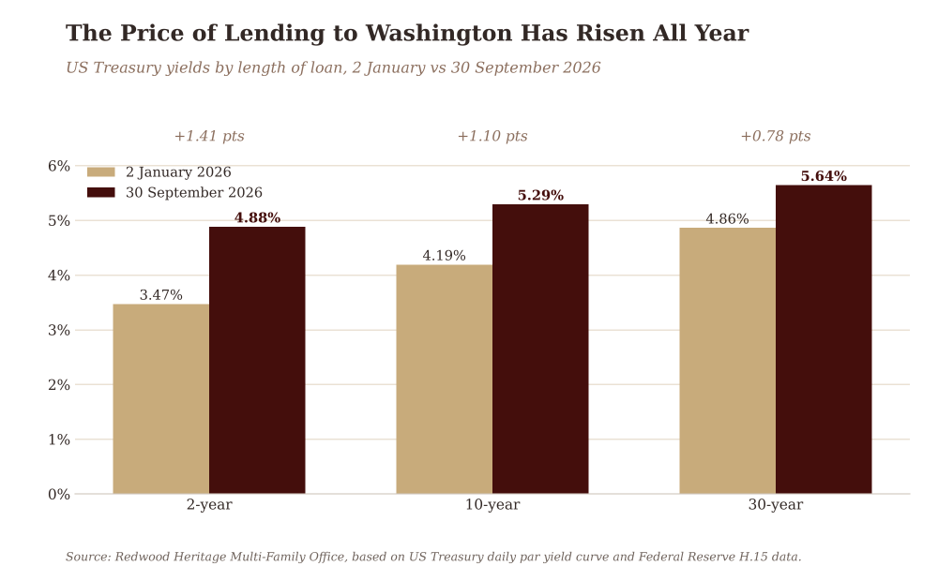
The record is plain. America’s total debt passed $40 trillion on 18 August. In the first nine months of this fiscal year the government spent $827 billion on interest, more than the $713 billion it spent on defence. Prices rose 3.4% in the year to August, well above the Federal Reserve’s 2% goal. Borrowing has become more expensive at every length of loan. Since 2 January the 2-year Treasury yield has risen from 3.47% to 4.88%, the 10-year from 4.19% to 5.29% and the 30-year from 4.86% to 5.64%. On 30 September the 10-year touched levels last seen in 2007, and the 30-year stood near its highest since 2002.
America is not alone. On 1 October Britain’s 30-year borrowing cost came close to 6%, its highest since 1998. France’s 10-year rose to almost 5%, its highest since 2002, and the gap between what France and Germany pay to borrow widened to its largest since the euro crisis of 2011 and 2012. In Japan, the 10-year yield rose above 3% on 24 September for the first time since 1996. These governments have different politics and different central banks, yet their lenders are sending the same message. In our view, mature economies can no longer borrow without limit and without cost, and the people funding them now want to be paid for the risk of being repaid in weaker money.
A debt repaid with inflation is a debt repaid by the lender.
Inflation Is a Tax Nobody Votes For
Growing out of a large debt is the route every government hopes for. When growth falls short, a government that owes more than it can comfortably carry has four ways out: it can raise taxes, cut spending, refuse to pay, or allow prices to rise faster than its interest bill. The first three require a decision that someone must defend in public. The fourth requires only patience. That is why we have long expected inflation, rather than austerity or default, to carry most of the weight, and why last week’s remark matters. The borrower has now acknowledged the option openly.
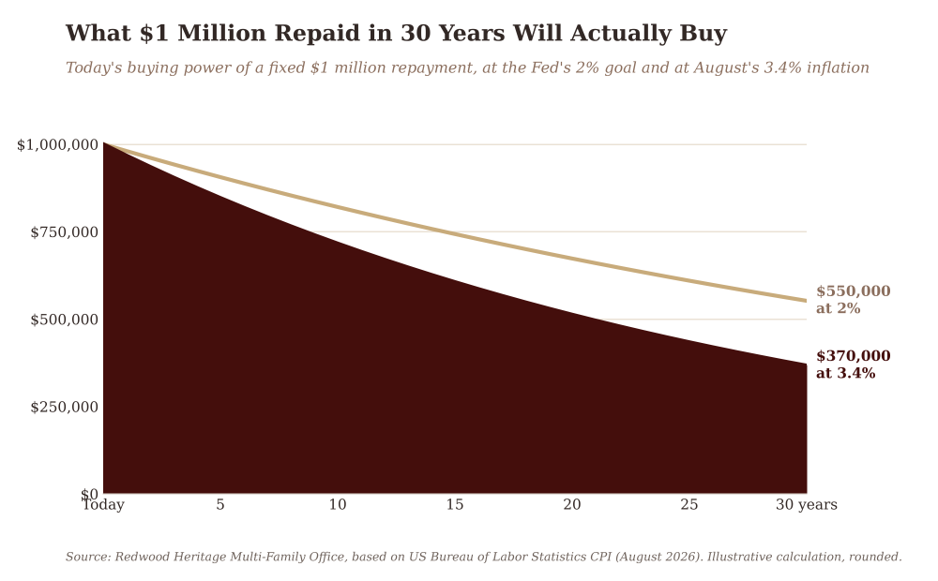
The arithmetic is simple. A government that borrows $1 million for 30 years pays back $1 million, however much prices have risen in between. If prices rise at the Federal Reserve’s 2% goal, that repayment buys about $550,000 of today’s goods. At August’s 3.4%, it buys about $370,000. No law is passed and no tax is announced, yet close to two thirds of the lender’s money is gone. Governments have done this before. In a 2015 paper in Economic Policy, Carmen Reinhart and Belen Sbrancia showed that advanced economies kept interest rates below inflation in about half the years between 1945 and 1980, and they called it what it is: a tax on bondholders and savers.
The Warnings Were Already on the Record
None of this arrived without warning, and our Founder & CEO has been writing it down as it came. In May he wrote that “the war may end. The inflation shock may not.” In June, in “The Portfolio Built For Lower Rates Has A Problem”, he argued that too many portfolios had been built to need falling rates rather than simply benefit from them. In “Risk-Free No Longer” he made the case that the government bond, the asset every portfolio treats as its anchor, had stopped deserving that name. In “Your Portfolio Is Still Living In 2020” he explained why inflation had left central banks unable to rescue portfolios by cutting rates. Trump’s remark ties these threads together. Inflation is staying, rates are not coming down to rescue anyone, and the safest asset on paper is the one an indebted government has the strongest reason to erode.
The Long Bond Is Now the Riskiest Safe Asset
Families who built their portfolios around long government bonds did so for good reasons. For decades the long bond paid a fair return, usually rose when shares fell, and asked little of the family that held it. Today a 30-year yield of 5.64% looks generous, but at current inflation it leaves about 2.2% a year before tax, fixed for three decades, while the risk of higher inflation sits entirely with the holder.
The lender is now caught between a central bank trying to bring prices down and a president who has said he could live with them going up. That is an uncomfortable place to stand for thirty years. When markets begin to doubt a government’s finances, long bonds also tend to fall at the same time as shares, so the protection a family paid for can disappear at the moment it is needed most. The operating business, the property and the liquid portfolio are then tested together, and only a view of the whole balance sheet shows how they will behave.
The longer you lend to a government that welcomes inflation, the more of its debt you repay.
This Is Not the Moment to Self-Medicate
No family alive has managed wealth through this combination before: record debts, inflation above target, central banks unable to cut, and governments with every reason to let prices run. The questions it raises cut across the whole family balance sheet at once: how long to lend and to whom, which currencies to hold, what the operating business and the property can bear if prices keep rising, and how the structures holding the wealth respond. No single product answers them, and an adviser with products to place is not best positioned to answer them impartially.
Our work rests on three disciplines. Architecture comes first: we design the system before we select the products, so that every holding has a defined role, whether that is protecting purchasing power, providing liquidity or building long-term growth. Governance follows: the family and its investment committee agree in advance, and in writing, the conditions under which the allocation changes, so that decisions are taken with judgement rather than on the worst day of a selloff. Stewardship completes it: wealth is judged by what it will buy for the next generation, and inflation is the risk most likely to erode that over time.
A family facing a serious diagnosis would not treat itself, and it would not rely on whoever happened to sell it the last prescription. It would find a specialist it trusts and act on a plan rather than a reflex. Capital in uncharted territory deserves the same discipline. That belief is why our Founder & CEO built this firm founder-owned and free of conflicts, and why we expect the families who come through this period best to be those who sought independent advice early and treated their long government bonds as a position to be managed, not a foundation to be assumed.
In uncharted territory, the most expensive decision is the one a family takes alone.
Conclusion
With American borrowing costs up all year, Britain, France and Japan paying their highest in decades, US debt above $40 trillion, interest costing more than defence, and a president now saying out loud that inflation will help pay it off, the message to anyone lending a government money for 30 years is clear. The bill has an address.
We would put two questions to every family this month. If prices kept rising at today’s 3.4% for a decade, what would your safe money buy when it came back? And who, with nothing to sell you, has actually tested your whole balance sheet against that outcome?
Governments decide how their debts are paid. Families decide whether they face the bill alone.
We publish The Family Office Perspective every week. Read deliberately, share with one person responsible for serious family capital, and subscribe.

