



A family should settle what its capital must do, when it may be needed and who may act before any asset is chosen.
Before deciding how capital should be invested, a family needs clarity about what that capital must do, when it may be needed and who has authority to act. Those decisions give an allocation its foundations. Many portfolio conversations begin at the other end, with markets, managers and products, because that is where the activity is and where most of the industry is organised to meet its clients. At Redwood Heritage, investment architecture begins with the family’s objectives, governance and liquidity requirements. Asset allocation follows within that framework. Managers and products are selected against the resulting mandates.
The academic literature arrived at the same order some time ago. Harry Markowitz showed in 1952 how assets could be combined to earn the most return for a given level of market risk. In Beyond Markowitz, published in The Journal of Wealth Management in 2005, Ashvin Chhabra argued that this market risk framework needed supplementing for private investors, whose wealth must also secure a way of life and fund ambitions that markets alone will not deliver. He proposed dividing a family’s wealth by the risk each part is meant to bear: personal risk for what the family cannot afford to lose, market risk for capital invested to maintain its position, and aspirational risk for capital deliberately committed in pursuit of something larger. Chhabra has since argued that this allocation of risk should come before the choice of asset classes, managers or securities.
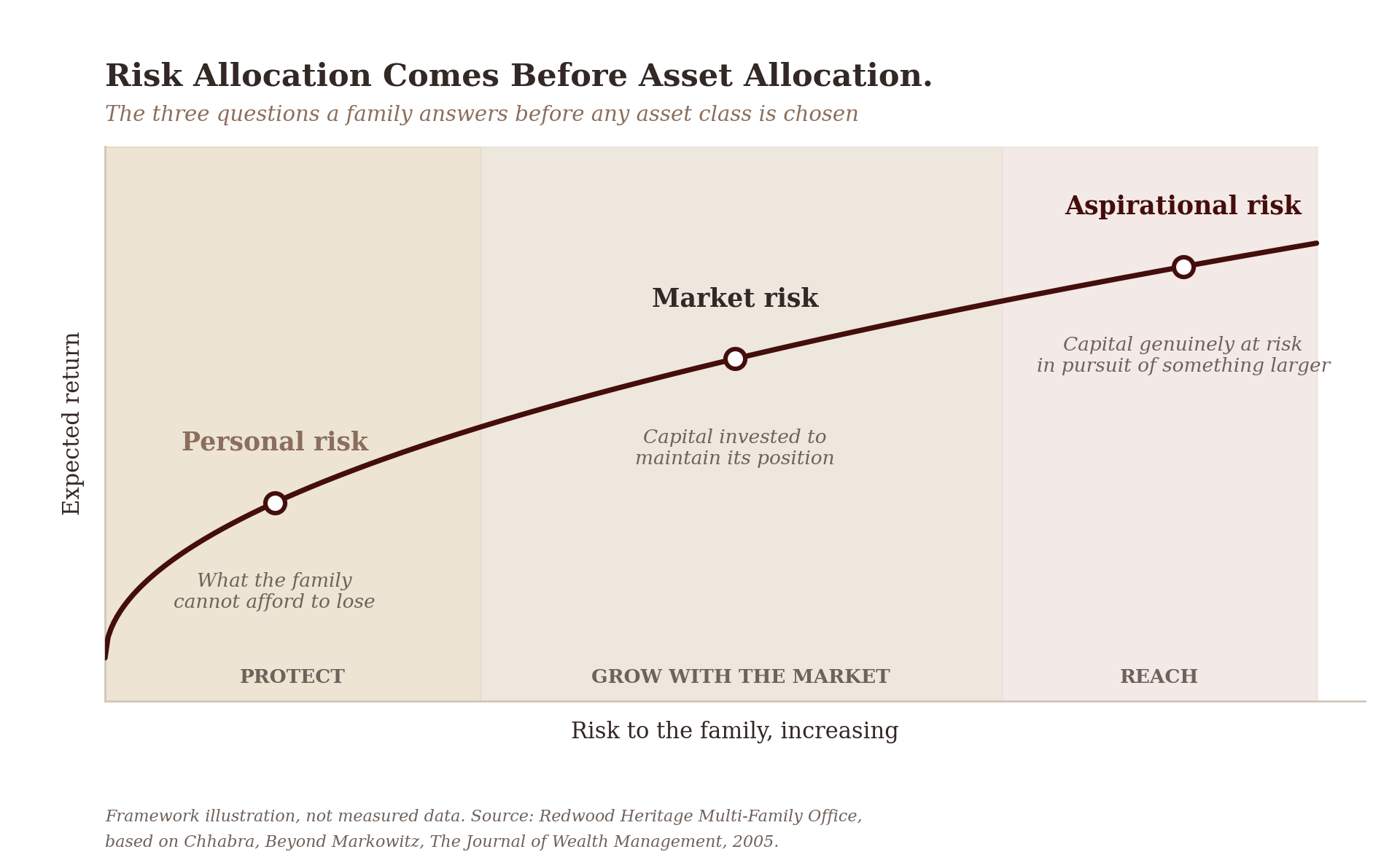
The illustration places those three purposes along a single curve, with expected return rising as the family accepts more risk. For a family, the value lies less in the shape of the curve than in the order of the questions it implies. A family that knows which capital sits in the protected portion, which is invested to keep pace with markets and which can be committed with genuine conviction is in a position to choose instruments for each. A family that begins with the instruments tends to discover the purposes later, often at an inconvenient moment, when a capital call, a distribution or a business need arrives before the portfolio is ready for it.
An allocation is only as sound as the decisions made before it.
Give Each Pool of Capital a Purpose
Capital intended to meet near term obligations has a different role from capital available for future generations. The first must be available on the day it is needed, in the currency in which it is needed. The second can accept years of variation in value in return for growth that compounds across a generation. Held together in one undifferentiated portfolio, the two tend to produce an allocation that serves neither well, too cautious for the long horizon and too exposed for the near one.
A family may also need to fund a business, support private investment commitments or provide distributions to several households. Considering those purposes explicitly makes the investment discussion more useful. Each pool can then be given its own time horizon, its own tolerance for loss and its own measure of success, and progress can be judged against what the family actually requires rather than against a market index chosen for convenience. The question becomes how each pool should serve the family, and how the pools work together.
Establish Who Can Decide
Two families can begin with similar portfolios and respond very differently when conditions change. One has agreed allocation ranges and delegated authority. The other must seek agreement among several principals before making an adjustment. In our experience the difference is invisible in a calm market. In a sharp one it decides whether a rebalancing takes place within days or only after the moment has passed.
Neither arrangement should be left implicit. The family needs to understand how decisions will be reached, which matters require consultation and what can proceed within an existing mandate. Where several generations or branches share capital, the same clarity extends to who sits on the investment committee, how votes are counted and what happens when principals disagree. These questions are best answered while relations are settled and markets are orderly, because neither condition can be relied upon when the answers are most needed.
Clear authority supports considered action. It also allows a deliberate decision to hold, without confusing conviction with an inability to decide.
Clear authority allows a family to act, and equally to hold, by choice rather than by default.
Read Liquidity Across the Whole Balance Sheet
Liquidity planning should account for the obligations surrounding the portfolio. Business funding, property commitments, borrowing, private market capital calls and family distributions all affect the capital available for investment. Each draws on cash according to its own timetable, and few of those timetables are set by the family.
An allocation that appears appropriate in isolation may place pressure on the family when those demands coincide. A portfolio can look comfortably liquid on its own statement while the family behind it carries loan covenants, a property payment schedule and undrawn fund commitments that would all call on the same cash in a difficult year. Considering them together helps establish how much flexibility the portfolio needs to preserve, and which assets can be relied upon to provide it without a forced sale.
This broader perspective is central to Redwood’s approach to investment architecture. We read the portfolio as one part of the family’s balance sheet, alongside its operating businesses, real estate and liabilities, because that is how the family experiences its wealth.
Translate the Framework into Written Policy
An investment policy statement connects family intentions with practical investment decisions. It should record the purpose of the capital, allocation ranges, liquidity requirements, delegated powers, review arrangements and the process for making changes. Once written, these become a reference that outlasts any single meeting, adviser or market episode.
Good policy leaves room for judgement. It defines where that judgement can be exercised and when the family should be consulted. A well drafted statement accepts that circumstances will arise which no document anticipated, and establishes in advance who decides when they do.
The amendment process deserves explicit attention: the framework needs to evolve as the family’s circumstances change. Marriages, the sale of a business, a new generation reaching adulthood and a change of residence all alter what the capital must do. A policy that cannot be amended in an orderly way is eventually set aside, which leaves the family with the appearance of governance and little of its protection.
Build Continuity into the Arrangement
When investment decisions depend heavily on one principal’s knowledge, a transition can leave others uncertain about both the reasoning and their authority. The founder may know precisely why a position is held, which commitments are coming due and which relationships matter. If that understanding rests with one person alone, the portfolio passes to the next generation without its instructions.
Documenting the framework gives family members and advisers a clearer basis for continuing the work. It makes the intentions behind the portfolio more accessible to those who may later assume responsibility, and it allows the next generation to question the framework from a position of understanding. Continuity in this sense means preserving the reasoning, so that each successor can decide with care what to keep and what to change.
A portfolio that passes without its reasoning passes without its instructions.
Conclusion
A purpose for each pool of capital, clear authority over decisions, liquidity read across the whole balance sheet, a written policy that can evolve and a record that survives a change of hands together give an allocation its foundations, and only on those foundations does the choice of asset classes, managers and products carry its full weight. The order matters.
For a family, or an investment committee acting on its behalf, two questions are worth asking before the next allocation review. Could each principal state what their capital is for and who has authority to change how it is invested? And if the principal who holds the reasoning were unavailable tomorrow, would that reasoning be available to those who would take responsibility for the portfolio?
Settle the governance first. The allocation will follow.
Begin with the Framework Behind Your Portfolio
Redwood Heritage brings governance, liquidity and investment oversight into the same conversation. The purpose is to establish a coherent relationship between your family’s needs and the capital intended to meet them, before individual investments dominate the discussion.
Arrange a private consultation to examine whether your current portfolio, mandates and decision rights reflect the family they are intended to serve.

