


The model a family chooses decides who carries the people, the systems and the cost. Scale, and now artificial intelligence, have changed that arithmetic.
The choice of family office model shapes more than how investments are managed. It determines who employs the team, maintains the systems, coordinates advisers and carries responsibility when circumstances change. Asset size matters, as do the complexity of the family’s affairs and the role the family wants to play in managing them. The right arrangement should give the family the oversight it needs, at a level of organisational responsibility it is prepared to carry and at a cost that reflects the work actually being done.
That last consideration deserves more weight than it usually receives. Campden Wealth and AlTi Tiedemann Global surveyed 146 family offices between November 2024 and March 2025 for The Family Office Operational Excellence Report 2025. Among the North American offices, average annual operating costs ranged from $1.2 million for offices managing less than $250 million to $6.8 million for those managing more than $1 billion. Measured against the assets they serve, the order reverses: about 61 basis points a year for the smaller offices, 40 for the midsize and 20 for the largest. A basis point is one hundredth of 1%, so the smallest offices spend roughly three times as much of every dollar on running themselves as the largest do.
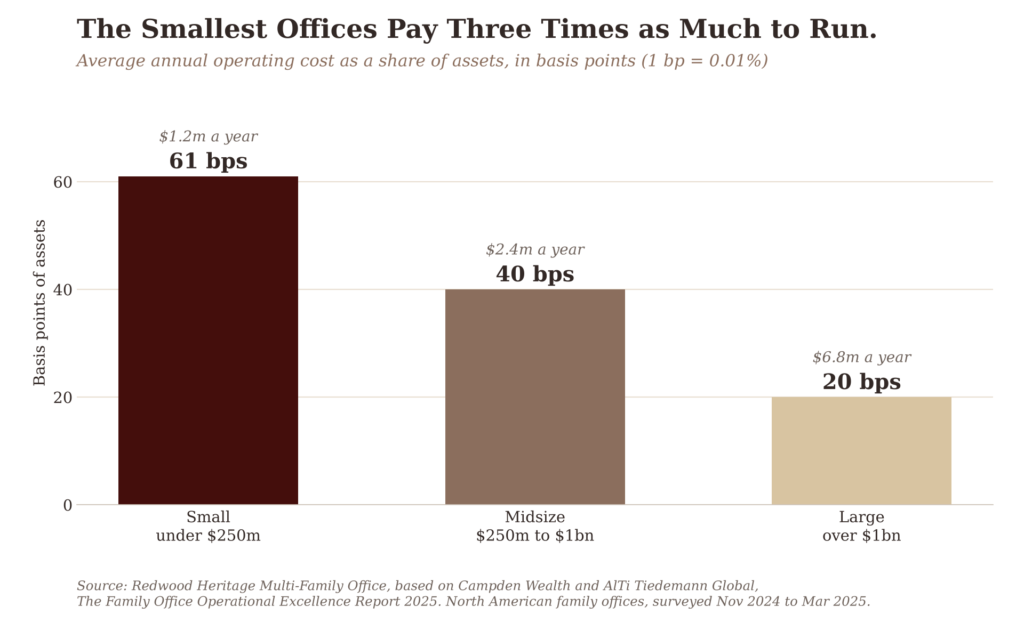
The pattern is consistent across studies. RBC Wealth Management’s North America Family Office Report 2024 found average costs of 98 basis points for offices with less than $500 million and 42 basis points for those above $1 billion. The reason is structural. A family office carries costs that do not shrink with the portfolio: senior people, reporting systems, legal and compliance work, cybersecurity and premises. Those costs behave largely as fixed costs, and a fixed cost spread across fewer assets weighs more heavily on each of them.
A family office carries costs that do not shrink with the portfolio.
A Dedicated Office: Control with Responsibility
A single family office allows a family to build an organisation around its own priorities. The team serves one family, and its systems, working practices and capabilities can be designed around that family’s affairs. Where the scale and complexity of those affairs justify it, this remains a sound model.
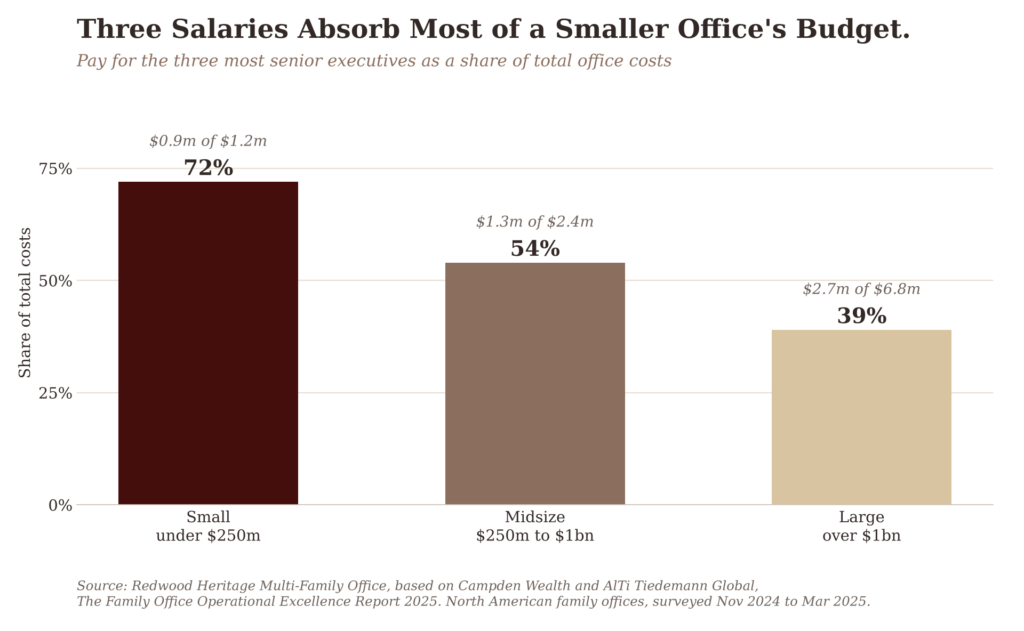
That degree of control comes with responsibilities: recruitment, retention, technology, information security, operating costs and succession within the office itself. The same report shows how much of the budget leadership alone absorbs. In the smaller North American offices, pay for the three most senior executives averaged $0.9 million, or 72% of total costs, against 39% in the largest. Across the survey, 70% of family offices reported difficulty hiring and 65% were concerned about retaining key staff. Cybersecurity ranked as the foremost operational concern for 70%, and more than 60% had experienced at least one cyberattack. External specialists are still needed, and someone inside the office must oversee their work.
A dedicated office can be a strong fit where the family’s needs justify building and maintaining that organisation. Below that scale, the family often pays for an institution in order to receive a service, and most of what it pays goes to keeping the institution standing.
Artificial Intelligence Rewards Scale
The economics are now moving further in the same direction. Consolidated reporting across custodians, document review, portfolio monitoring, risk analysis and research can increasingly be supported by artificial intelligence, and the Campden report notes that early adoption is already under way in research, reporting and risk management. These capabilities are expensive to build properly. They require specialist people to govern them and careful security, because the data they draw on is the family’s most private information.
Inside a single family office, that investment sits on one balance sheet. The smaller North American offices in the survey spent an average of $0.1 million a year on their technology, against $0.6 million in the largest. A multi-family office builds its infrastructure once and applies it across every family it serves. Each family gains an institutional platform, with data security, model oversight and continuous improvement funded collectively, while its own information remains segregated and its own mandate remains distinct. This is economies of scale in its plainest form, and the advance of artificial intelligence tends to widen the gap between the two models with each year that passes.
Built once and shared across families, institutional infrastructure becomes affordable for every family it serves.
A Multi-Family Office: Access to an Established Organisation
A multi-family office offers access to capabilities and infrastructure shared across several family relationships. The family gains a senior team, specialist expertise, consolidated oversight and a technology platform without employing, housing or replacing any of them. Continuity improves as well. When an individual moves on, the knowledge, systems and records remain with the firm, and the relationship continues.
The test is how those resources are applied to your circumstances. Examine the people who will work with you, their responsibilities, the scope of the mandate and the arrangements for continuity. For families that want coordinated oversight without assembling every function internally, this is in our experience the more compelling model, and for many it is also the more economic one.
Redwood Heritage’s approach centres on the family’s governance, investment architecture and wider balance sheet. The relationship is defined around the work required and the responsibilities the family wishes to delegate. The firm is founder owned, which keeps its interests aligned with the long horizon of the families it serves.
A Blended Arrangement: Keeping Selected Functions Close
The choice need not be absolute. A family may retain an internal team for administration and family matters while appointing external support for investment architecture, consolidated oversight or the coordination of specialist advisers. This preserves direct control over selected functions while limiting the breadth of expertise, and the fixed cost, that the family must maintain in house. Redwood can be considered within that arrangement as well as by families establishing their first formal office framework.
What Both Models Require
Whichever structure a family chooses, certain questions remain. Who can make decisions? How are conflicts managed? What does the arrangement cost in full, including salaries, systems, premises and the advisers the office itself must appoint? How is performance assessed, and what happens when a key person leaves?
Employing a team directly does not remove the need for governance. Appointing an external firm does not remove the need for informed oversight. The strength of either model depends on clearly assigned responsibilities and a disciplined relationship between the family and those serving it.
Employing a team does not remove the need for governance. Appointing a firm does not remove the need for oversight.
Conclusion
Running costs that fall from about 61 to 20 basis points as an office grows, a leadership payroll that absorbs close to three quarters of a smaller office’s budget, and technology whose value rises with the number of families it serves together point most families in one direction: towards shared infrastructure, with the family’s own governance kept firmly in its hands.
Two questions are worth asking before deciding. What would it cost, in full and every year, to build and secure on its own the capabilities the family needs? And how much of the family’s time should be spent managing that organisation, when the organisation exists to serve the family’s wealth?
Scale belongs to the platform. Control belongs to the family.
Choose Around the Life Your Family Wants
A business sale, international expansion or generational transition can change what a family needs from its office. The decision should reflect both the affairs being managed and how much time the family wants to devote to managing the organisation around them.
Speak with Redwood Heritage about the responsibilities you want to keep close, the capabilities you need and the structure that could serve your family over time.

