



Five questions that separate a persuasive introduction from an arrangement a family can rely on for a generation.
A family can have excellent banks, capable investment managers and experienced advisers, yet still carry the responsibility of making everything work together.
Choosing a multi-family office means deciding who will help carry that responsibility. The appointment should bring clarity to how your wealth is organised, how decisions are made and whose interests those decisions serve.
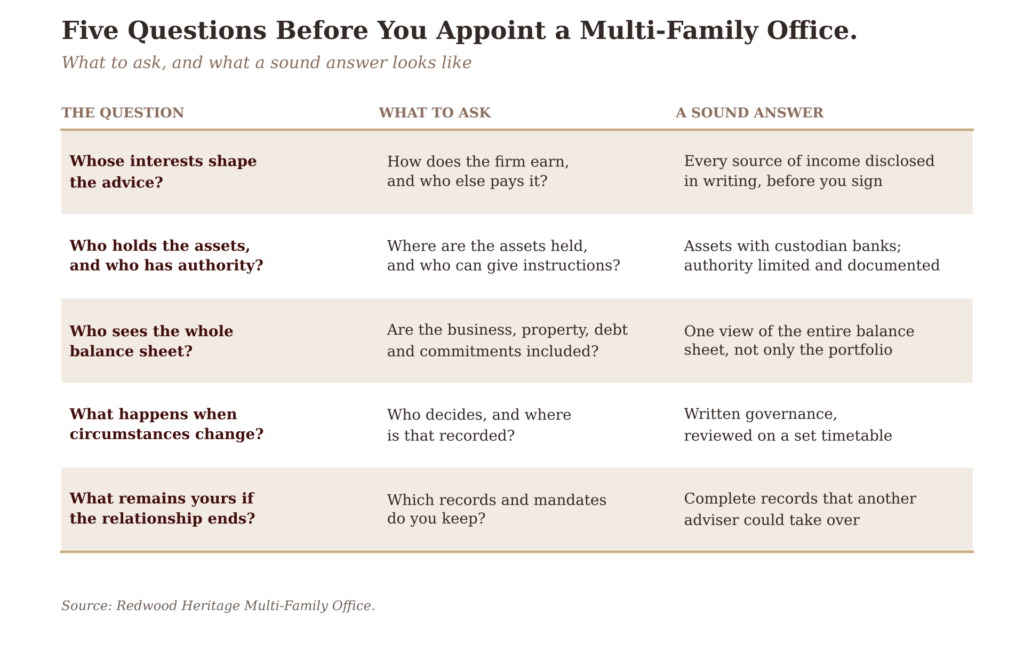
Five questions help distinguish a persuasive introduction from an arrangement your family can rely on.
The first question carries the most weight, because the evidence on conflicted advice is consistent. In a study published in The Review of Financial Studies in 2009, Daniel Bergstresser, John Chalmers and Peter Tufano compared mutual funds sold through brokers with funds bought directly between 1996 and 2004. The broker-sold funds delivered lower risk-adjusted returns even before distribution costs were deducted, and the authors described their results as consistent with material conflicts of interest between brokers and their clients. In 2015 the White House Council of Economic Advisers reviewed the research and concluded that savers receiving conflicted advice earn returns roughly 1 percentage point lower each year, at an aggregate cost of about $17 billion a year in American retirement savings alone.
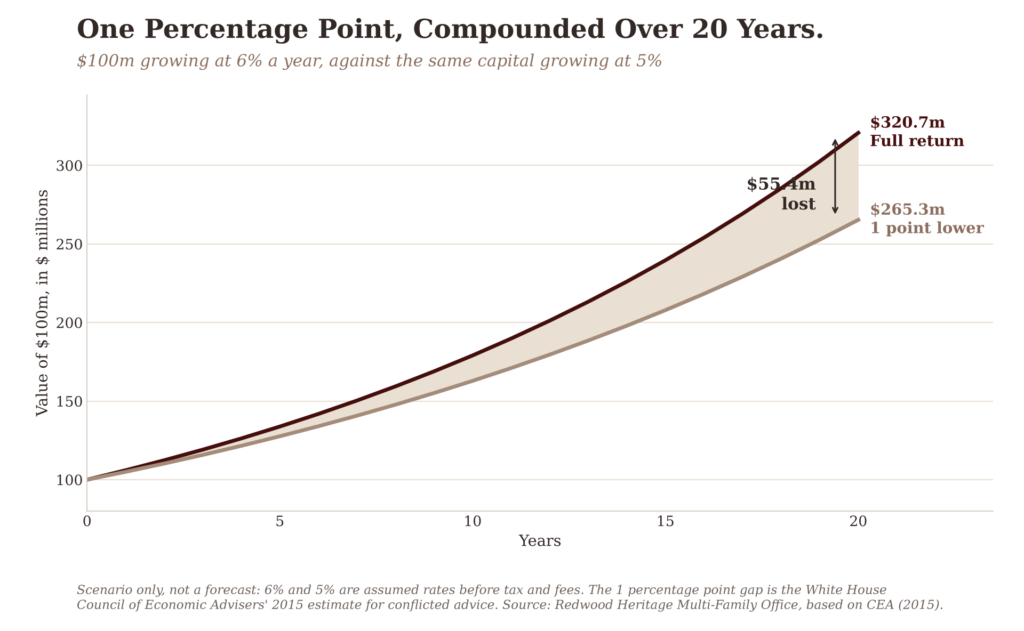
One percentage point sounds modest. Compounded, it is not. In the scenario above, $100 million growing at 6% a year reaches about $320.7 million after 20 years, while the same capital growing at 5% reaches about $265.3 million. The difference of roughly $55 million is never sent as an invoice. It appears only as wealth the family never had. The estimate comes from retirement savers rather than wealthy families, but the mechanism is identical wherever an adviser is paid by the products it recommends.
The most expensive part of advice is often the part nobody discloses.
Whose Interests Shape the Advice?
Begin with remuneration. Ask how the firm earns, which relationships generate additional income and how potential conflicts are disclosed and managed. Additional income can take several forms: commissions or rebates from product providers, a share of the fees charged by funds or banks, or margins on products the firm itself creates. None of these is visible on a statement unless the firm chooses to show it. A firm with nothing to hide will answer in writing, in full, before you sign.
Then examine the sequence of the conversation. Does the firm begin with your family’s objectives, obligations and existing arrangements, or does the discussion move quickly towards investments? A firm that leads with products is telling you how it is paid.
At Redwood Heritage, our starting point is the family: what its capital must support, which responsibilities need coordination and where greater oversight would be valuable. That understanding gives every subsequent recommendation its purpose. Redwood is founder owned, so there is no parent institution whose products we are expected to place, and our advice answers to the family.
Who Holds the Assets, and Who Has Authority?
Knowing where assets are held is essential. So is knowing who can instruct the institutions holding them. In plain terms, custody means the bank that holds the securities in the family’s name, and authority means who is allowed to tell that bank what to do. Custody, signing rights and delegated authority deserve separate answers. In a sound arrangement, assets remain with established custodian banks in the name of the family or its structures, and any authority given to an adviser is limited, written down and revocable.
Establish what the firm may do, what requires your approval and how those permissions are documented. Clear boundaries support a productive relationship. Your family should understand both the responsibility it delegates and the control it retains.
Who Sees the Whole Balance Sheet?
A securities portfolio may represent only one part of your wealth. Operating businesses, property, borrowing and private commitments can determine how much liquidity the family actually has. A firm that sees only the portfolio is advising on a fraction of the family’s position while the decisions that matter most are taken elsewhere.
Ask how those exposures enter the discussion. A portfolio allocation should be considered alongside the obligations and concentrations elsewhere in the family’s affairs. Redwood’s Strategic Wealth Architecture begins with that broader perspective. The objective is to connect decisions that would otherwise be taken separately, so that the portfolio is built for the family as it really is.
A firm that sees only the portfolio is advising on a fraction of the family.
What Happens When Circumstances Change?
An effective arrangement must accommodate a business sale, a move between jurisdictions, a new generation or the absence of a principal. These are the moments when families most need clarity and when informal arrangements are most likely to fail.
Ask who can decide, where those responsibilities are recorded and how the framework is reviewed. Governance gives continuity a practical form. At Redwood, decision rights, mandates and review dates are written down from the start, so the arrangement is ready for change before change arrives.
What Remains Yours if the Relationship Ends?
Reporting records, ownership information, documented mandates and decision history should support the family’s continuity. Ask what you would retain and how another adviser could assume responsibility.
This question reveals a great deal. A firm that makes leaving difficult is relying on inconvenience to keep the relationship. A firm confident in its value gives the family complete, organised records that it owns outright. A well organised relationship should strengthen the family’s position over time, whoever advises it in the future.
A firm confident in its value has no reason to make leaving difficult.
Conclusion
Disclosed remuneration, assets held safely in the family’s name, a view of the whole balance sheet, governance that is ready for change and records the family owns outright together mark the difference between a firm that sells to a family and one that works for it. A one percentage point conflict, compounded over a generation, shows how much that difference can be worth.
Two questions are worth putting to any firm before appointment. Will you set out in writing every source of income you would earn from our relationship? And if we decided to leave in five years, what exactly would we take with us?
Ask the hard questions first. The right firm will welcome them.
Begin with Your Existing Arrangements
The value of a multi-family office becomes clearer when the discussion moves from a service list to your circumstances.
Redwood Heritage brings a family perspective to governance, investment architecture and the coordination of advisers. We begin by understanding what already works, where responsibilities overlap and what currently depends on your personal attention. We welcome all five questions above, and we answer them in writing.
Arrange a private consultation to discuss how your family’s existing arrangements work together, and where greater clarity would make a difference.

