


Why What A Family Owns Describes Its Governance Better Than Anything It Has Written
Most families with serious capital are not ungoverned. They are governed on paper only. The constitution exists, the family council meets, the investment policy was drafted by competent people, and the succession plan took two years and a serious amount of money to produce. All of it is genuine work, and most of it is well done.
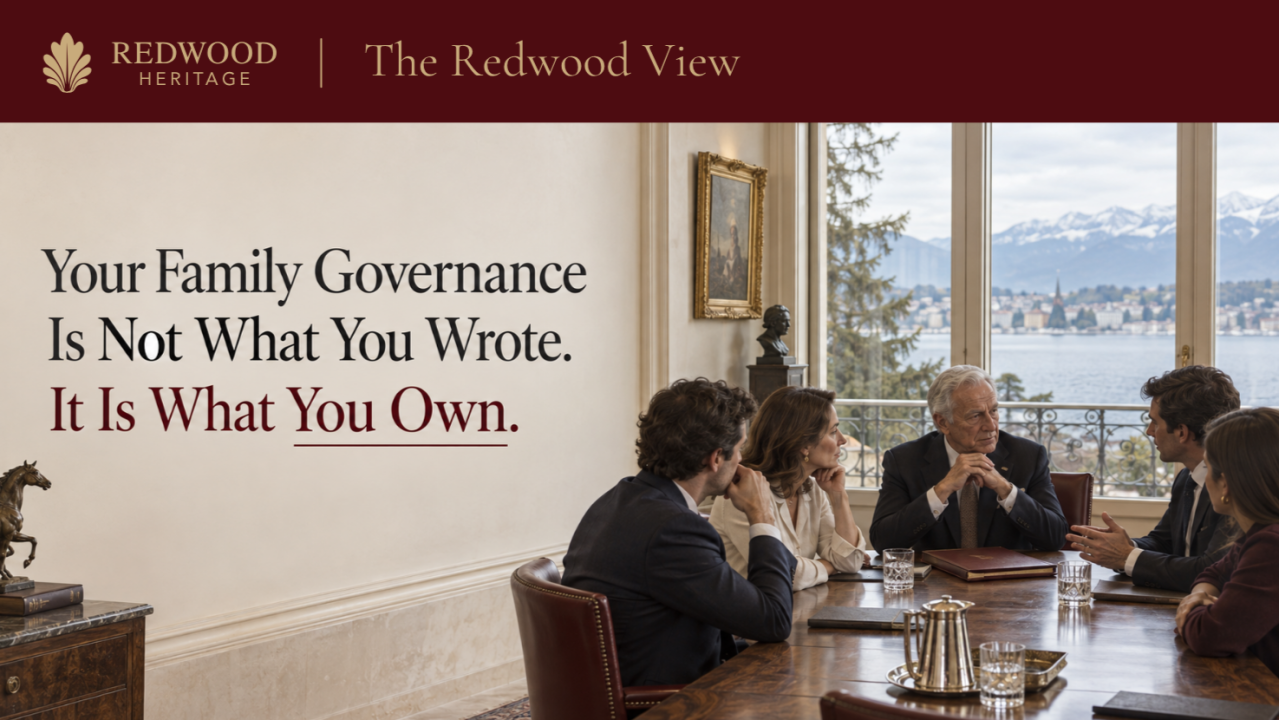
The question that exposes the gap is a simple one. What has any of it changed about the asset allocation. In our experience the answer is rarely a defense. It is silence, because the documents and the portfolio have never been in the same conversation. One set of papers describes a family that decides things deliberately and together. The portfolio describes what the family owns. Only one of them is a record of what actually happened.
One set of papers describes a family that decides things deliberately and together. The portfolio describes what the family owns. Only one of them is a record of what actually happened.
Nothing Was Designed. It Was Accumulated.
Most large portfolios are not built. They are assembled. A private bank proposes a structured note. A manager arrives with a fund that is closing soon. A friend brings a co-investment that is genuinely good. Each decision is examined carefully and each one is defensible, and after fifteen years the family owns a collection of individually reasonable choices that were never made in relation to one another.
Nobody ever sat down and decided the shape of the whole thing, because at no point was that anyone’s job. We have written before that most wealthy families are not under-advised but over-surrounded. This is what that produces.
The pressure to keep adding has rarely been higher. UBS surveyed 307 family offices this year and found 60% intending to change their strategic asset allocation over the next twelve months, against 35% a year earlier. In the Middle East the figure reaches 82%. Movement on that scale is not the problem. The problem is that a portfolio can be rearranged every year and still never be designed.

Architecture is the opposite of that, and it comes first. What is this capital for. Over what horizon, in which currencies, and with what call on it in which year. What must never be sold, and what exists precisely to be sold when something goes wrong. Only once those answers exist does the question of instruments arise. Redwood designs the system before selecting the products, and the order is the entire point, because a product chosen before the system exists will always be justified after the fact.
This is also where ownership stops being an abstraction. A firm that earns more from one answer than another will find reasons for that answer, and they will be good reasons, arrived at honestly by people who believe them. That is what makes it difficult to see from the outside. The only reliable protection is a structure in which nothing the adviser earns depends on which instrument the family chooses, and that is a decision about how a firm is owned rather than a promise about how it behaves.
The Allocation Is The Governance
Four facts tell you more about a family’s governance than any document it has ever produced. Where the capital is concentrated. How much liquidity is held against how many committed obligations. Who is permitted to sign a ten-year lock-up. And what happens when two of those assumptions fail in the same quarter.
Answer those and you have described the family’s real authority structure, including who actually decides, which is frequently not the person named in the constitution. If one member can commit to a decade without the council seeing it, the council does not govern, whatever the document says. If 40% of the capital is illiquid and nobody in the room can state the figure, then the investment policy is not a policy, it is a description of intentions. Governance defines the asset allocation, and not the other way around. When the allocation is set first and the governance written afterwards to describe it, the family has documented its habits and called them a system.
If one member can commit to a decade without the council seeing it, the council does not govern, whatever the document says.
The Part That Has To Outlive The Adviser
The same UBS survey shows how uneven this is. Two thirds of family offices have formal performance measurement and 60% run an investment committee, yet only 35% have a defined succession plan for the family office itself and only 27% prepare the next generation in any structured way. The machinery for measuring this year is in place almost everywhere. The machinery for surviving the next twenty is in place almost nowhere.

Families do not want to change financial doctor every few years, and yet most do, because the industry is built in a way that makes it almost unavoidable.
Advisers move. Platforms are sold. Teams are restructured by owners who need a different number this year. Each time it happens the family keeps the assets and loses the memory, which is the part that actually mattered: why the position was taken, what it was protecting against, which assumption it depended on, and who agreed to it. Stewardship is the discipline of making that memory institutional rather than personal, so the reasoning survives the individual who set it down.
The family keeps the assets and loses the memory, which is the part that actually mattered.
Conclusion
Families in this position are not careless. Many have done more formal governance work than most ever do, and have paid properly for it. What has not been done, because nobody was asked to do it, is to connect any of that work to what the family owns. That connection is the whole of it. Governance that never reaches the allocation is a description of good intentions, filed neatly.
So put the four questions to whoever is responsible, and notice how long the answers take. Where is the capital concentrated. How much liquidity stands against how many commitments. Who may sign a ten-year lock-up. What happens if two of those assumptions fail at once. Good answers arrive with numbers attached and a memory of the meeting where each was set. Slow answers are the finding, because a position nobody can account for is a position nobody is governing.
A constitution records what a family believes about itself.
The portfolio records what it has actually done.
The Redwood View is published by Redwood Heritage Multi-Family Office. Architecture. Governance. Stewardship.
