


Wealth attracts advisers. A multi-family office makes sure one party answers for the whole.
As wealth grows, the number of relationships surrounding it tends to grow too. One bank holds the investment portfolio. Another provides lending. Lawyers maintain ownership structures. Accountants manage reporting obligations. Property and business interests follow their own calendars.
Each relationship may work well. The family still needs someone to connect the decisions. That is the coordinating role at the heart of Redwood Heritage’s multi-family office approach.
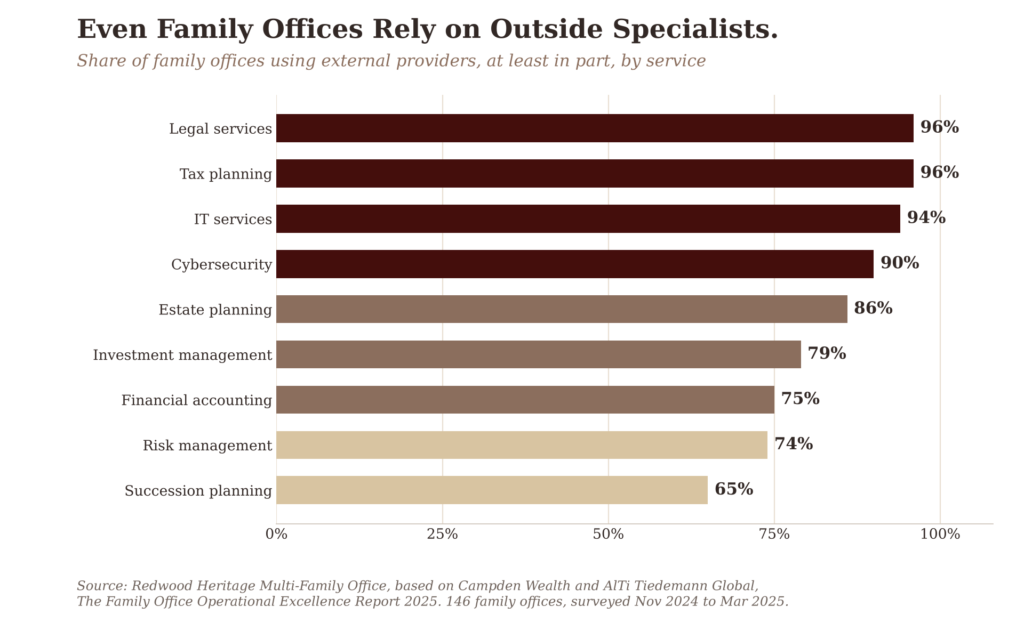
Fragmentation is the normal condition of family wealth. Campden Wealth and AlTi Tiedemann Global surveyed 146 family offices worldwide between November 2024 and March 2025 for The Family Office Operational Excellence Report 2025, and found that all of them outsource to some degree. Among those using outside providers, 96% did so for legal services and for tax planning, 94% for IT services, 90% for cybersecurity and 79% for investment management. Even families who have built an office of their own end up managing a crowd of outside firms.
Every additional firm brings another set of instructions, another reporting format, another fee and another commercial interest. A bank is rewarded for the assets it holds and the loans it makes. A fund manager is rewarded for the capital it manages. A lawyer is engaged for the structure in front of them. Each arrangement is organised around the firm’s own mandate, and none is organised around the family. Decisions therefore fall between the parties. A holding company is restructured without regard to the loan secured against it, or capital is committed to a fund in the same month that a large tax bill falls due. The family usually discovers the problem once it has already become expensive.
Every firm is paid for its piece. Nobody is paid for the whole.
Bringing the Family’s Objectives into Every Decision
Before anyone recommends an investment or a structure, the family needs to be clear about what its wealth is for. It may need income today, capital for the next generation, funding for a business, the means to change its country of residence and resources for philanthropy. Each of those goals makes a different demand on the same pool of money. Cash that must be available next year cannot also be committed for twenty, and no single bank or adviser is positioned to weigh one goal against another.
A multi-family office turns those priorities into an agreed framework for ownership, governance, liquidity and investment oversight. In plain terms, we write down what the money is for, who decides, how much must stay available and how every investment will be supervised. At Redwood this comes first, before any product is discussed. The mandate follows the family’s needs, and managers and products are then selected to serve it, never the other way around.
Connecting Decisions Across Institutions
Consider a private investment capital call arriving close to a tax payment and a planned family distribution. A capital call is a demand from a private equity or similar fund for money the family has already promised to invest, and it must be paid on time. Each of these obligations may be handled by a different firm, yet all three draw on the same cash. Seen separately, each looks manageable. Seen together, they can force the family to sell an investment at the wrong moment or to borrow at short notice and on someone else’s terms.
A multi-family office brings those commitments into one discussion months before they become urgent. The same discipline applies to borrowing, to a concentrated stake in the family business and to property. A family whose wealth is largely tied to one operating company, for example, has far less room to take risk in its portfolio than the portfolio statement suggests. We read these exposures together, because each one changes how much risk the family can safely take elsewhere. Without that coordination, the job falls to the principal, who rarely has the full picture and often learns of the clash too late.
Obligations managed by different firms still draw on the same cash.
Making Responsibilities Clear
Ask a family with several advisers who is responsible for the overall result, and the answer is frequently unclear. Each firm is accountable for its own mandate. Responsibility for how those mandates fit together is assumed by everyone and owned by no one, and that assumption tends to come to light only when something has already gone wrong.
Redwood resolves this through agreed mandates and governance. We sit on the family’s side of the table. We define what each bank, manager, lawyer and tax adviser is engaged to do, monitor what they deliver and make sure their work serves the family’s objectives. The scope is agreed in writing, so accountability no longer disappears between institutions. Because Redwood is founder owned, our interests remain aligned with the family’s over the long term.
Giving Information a Practical Purpose
Most families are buried in paper: statements from each bank, reports from each manager and accounts from each company, all in different formats and on different dates. Very few receive a single picture of where they actually stand, and without one, every decision is taken with part of the information missing.
Where is capital concentrated? Which commitments will need funding over the coming year? What can be reached quickly, and what is locked up for longer? Which decisions need attention now? Our consolidated reporting is built to answer exactly those questions on one view of the whole balance sheet, so the family can see its position clearly and act on it with confidence.
Supporting Continuity
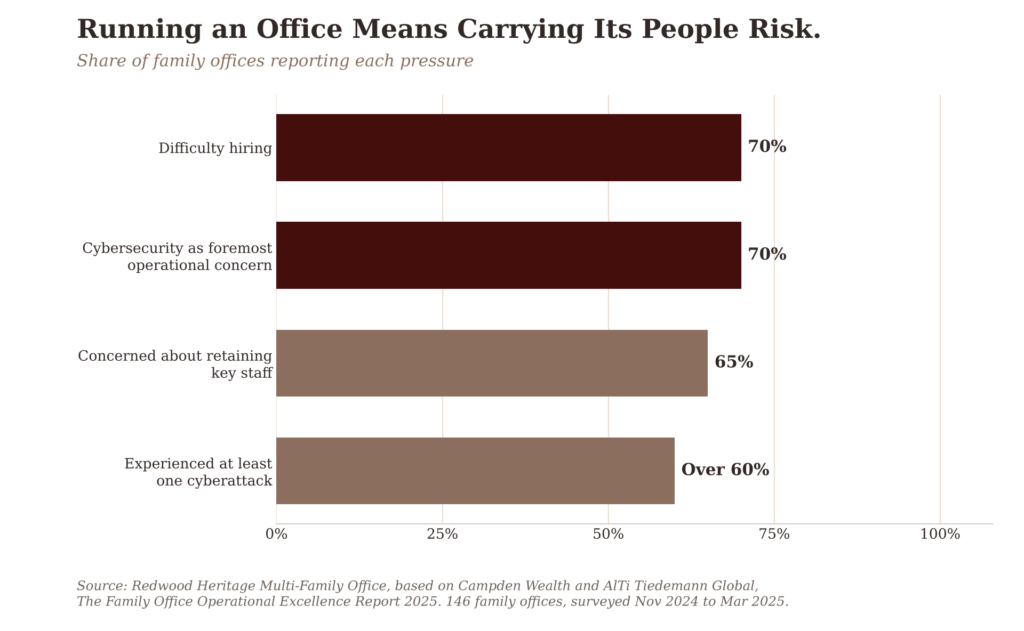
Arrangements built around one person’s knowledge are fragile. In many families, the principal alone knows why each structure exists, which adviser handles what and which commitments are coming due. Families that build their own team face the same exposure in another form. In the same survey, 70% of family offices reported difficulty hiring and 65% were concerned about retaining key staff, and the report places staff turnover among the most significant operational risks that family offices face.
Documented decision rights, clear mandates and coordinated information allow the next person to take responsibility with confidence, whether the change involves a family member, an adviser or a principal stepping back. A multi-family office adds a protection that no individual employee can provide. The knowledge rests with a firm, its team and its records, so the family’s affairs continue without interruption when people change.
When the knowledge sits with one person, the family’s continuity depends on that person staying.
Conclusion
Firms that each see one part of the picture, obligations that draw on the same cash from different directions, responsibility that everyone assumes and no one owns, and knowledge held by too few people all lead to the same conclusion. A family with significant wealth needs one party on its side whose job is to see the whole, connect the decisions and answer for the result. That is what a multi-family office does, and it is what Redwood Heritage is built to do.
Two questions settle the matter for most families. If a capital call, a tax payment and a family distribution fell in the same month, who would see it coming? And if the person who holds the family’s financial picture stepped back tomorrow, who could take it over the next day?
Advisers serve their mandates. Someone must serve the family.
Where Redwood Fits
Most families do not need more advisers. They need coordination between the ones they have, and one party answerable for the whole. Redwood Heritage provides exactly that, with governance, liquidity and investment architecture considered together. We work with the banks and advisers already in place, hold them to a single framework and take responsibility for making the whole arrangement work for the family.
Arrange a private consultation to explore which responsibilities your family wishes to retain, which it would like support with and how Redwood could bring your existing advisers under one coordinated structure.

