



The Economist’s latest cover asks a plain question: will bonds blow up. At Redwood Heritage we have long held that the 60/40 portfolio, 60% shares and 40% bonds, belongs to another era, and the portfolios we build for the families we advise are constructed across six asset classes rather than two, a discipline our Founder & CEO, Ahmad Saidali, has applied for more than 15 years. The case for 60/40 rested on a relationship: when shares fell, high-quality bonds tended to rise and soften the loss. That relationship depends on low and stable inflation and on lenders who trust the borrower, and both conditions are now in question. In this Brief we set out the evidence, and what it means for how a family holds its capital.
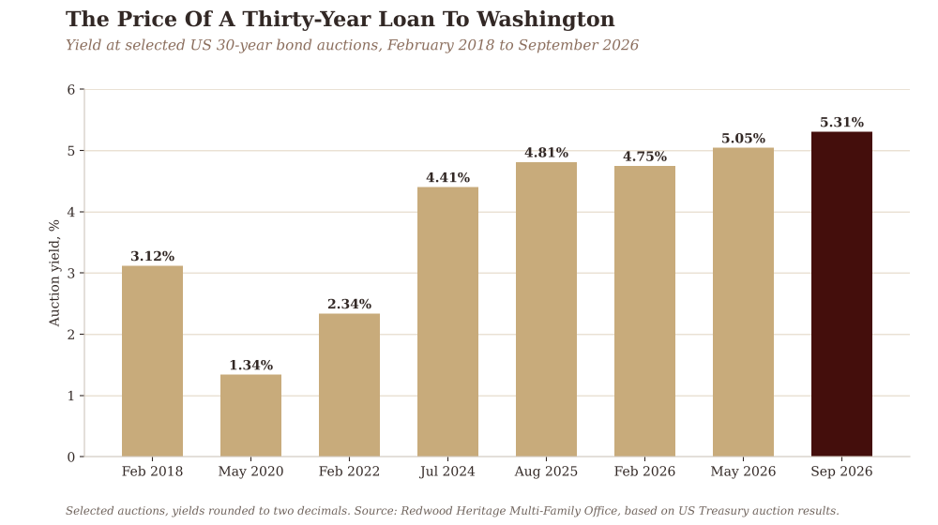
The numbers leave little room for comfort. According to The Economist, the public debts of the big advanced economies have roughly doubled since 2000, measured against the size of their economies. Even before the latest sell-off, these governments were expected to spend 8% of their tax revenue on net interest this year. In August, America’s federal debt crossed $40 trillion. On 10 September the US Treasury paid 5.308% to sell 30-year bonds, the highest yield at any such auction since August 2001, and on 8 October the 10-year Treasury yield touched 5.35%, its highest since 2002. It would not surprise us to see it test 6%, a level it last reached in 2000. By 5 October, Bloomberg’s index of global government bonds yielded 5.79%, while the MSCI World index of global shares stood at 4,954.
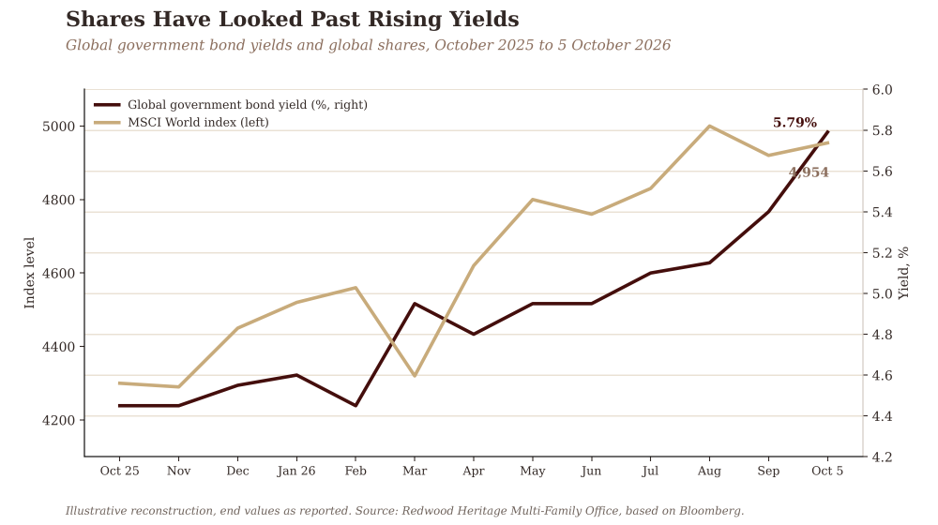
Rising yields mean falling bond prices, so the part of a portfolio intended to protect a family has been losing value while shares continued to climb. The real test comes in a falling market, when shares decline and the bonds meant to offset them may be falling at the same time, pushed down by the same concern about debt and inflation.
The Cushion Has Worn Thin
Seventy years of market data show how conditional that protection has always been. Using Robert Shiller’s long-run US market data, we measured whether US shares and 10-year government bonds tended to move together or apart over rolling three-year periods. For most of the period from 2000 to 2021, years of low and stable inflation, the measure was negative: bonds tended to rise when shares fell. From the late 1960s to the late 1990s, when inflation was the dominant concern, bonds tended to fall with shares. As inflation returned and yields rose in 2022 and 2023, the measure turned positive again.
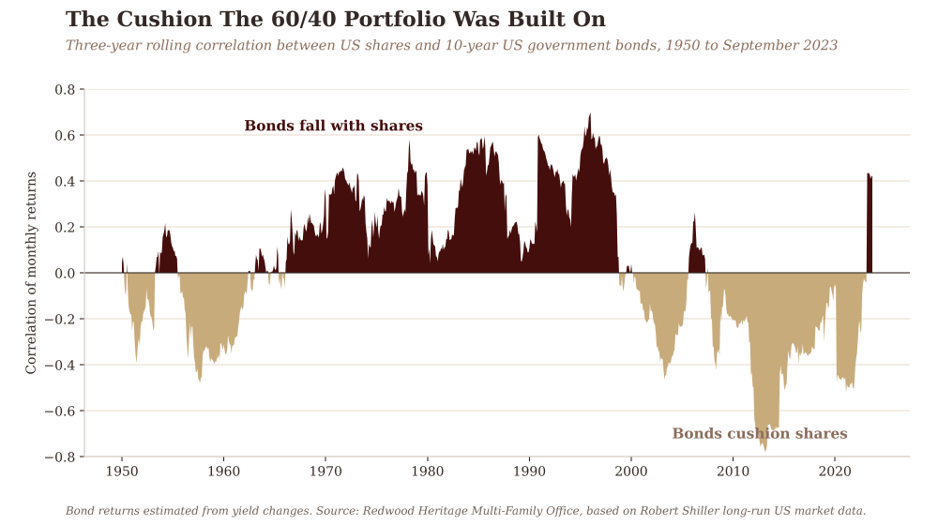
Academic research supports this reading. John Campbell, Adi Sunderam and Luis Viceira of Harvard show that the covariance between US Treasury returns and stock returns has moved considerably over time, and link those swings to whether investors regard government bonds as exposed to inflation or as protection when growth and prices fall. For families the implication is direct. A portfolio built on the assumption that bonds will cushion a fall in shares is built on a particular regime, and regimes change.
The airbag is now part of the crash.
The Lender Now Sets The Terms
A long-term yield has two parts: what lenders expect short-term interest rates to average over the life of the loan, and an additional reward for committing money for decades and carrying the risk that inflation or policy erodes it. A widely cited Federal Reserve study by Thomas Laubach estimated that a one percentage point increase in the projected US deficit, measured against the size of the economy, raises long-term interest rates by roughly 0.25 percentage points. This year’s 30-year auctions trace that pressure: 4.750% in February, 5.046% in May and 5.308% in September.
From Dubai, where capital from East and West now meets and chooses where to settle, we see the foundations of the old financial order under visible strain. For generations the large Western economies borrowed as though the money would always be available, and for generations it was. Their politicians have so far lacked the courage to tell voters plainly what that borrowing will cost. For decades the borrower set the terms. Today the lender does, and the lender’s patience is running out.
Switzerland Shows What Discipline Earns
Two neighbours make the point. In 2001 Swiss voters approved a debt brake by 85%, writing fiscal discipline into the constitution, and according to Avenir Suisse, Swiss public debt has since fallen from about 55% of the economy to roughly 35%. France’s public debt reached a record 119% of its economy at the end of June. On 9 October, markets demanded 4.87% to lend to France for ten years and about 0.56% to lend to Switzerland. As a firm with roots in Geneva and Zurich, we regard that gap as the price of fiscal courage, paid by those who lacked it.
Politics Has Joined The Auction
The language of some politicians explains why lenders have become more demanding, and The Economist has gathered the evidence. On 3 October, in The Family Office Perspective, our Founder & CEO examined Donald Trump’s remark to TIME that certain levels of inflation would pay off America’s debt very rapidly, which amounts to a promise to repay lenders in money worth less than the money they lent. Europe has its own versions. In France, lawmakers struggle to agree even small budget cuts while Marine Le Pen promises that the pension age can fall as people live longer. In Britain, an MP said that bond markets would simply have to fall in line with the Labour government’s spending plans. Lenders hear each remark as a warning, and they price that warning today.
The bond market hears what voters are not told.
The Old Shelters Are Moving
Gold, the other traditional refuge, has not escaped the pressure. It pays no interest, so higher yields raise the cost of holding it, and it now trades below the record it set in January. Markets also expect the Federal Reserve to continue after September’s increase, its first in three years, with a further quarter-point rise fully priced by December.
Government bonds still have a role. Long-dated US government bonds now pay more than at any 30-year auction since 2001. What has changed is how they should be held: as a return-seeking position, sized and monitored like any other, with the expectation that it may behave like one in a difficult year. Protection against inflation and fiscal disorder must increasingly come from elsewhere, and real assets are a natural place to look. Well-chosen property, infrastructure and productive land earn income from activity people continue to pay for, and those revenues have tended over time to adjust with the cost of living, while a fixed payment from a government is eroded by it. Real assets carry their own risks and demand patience and careful selection, which is why we select and structure them with the same discipline as every other part of a portfolio.
Six Asset Classes, Not Two
We have never trusted a portfolio that stands on two legs. The portfolios we build for the families we advise are spread across six asset classes, so that no single source of safety carries the whole weight and no single government’s promise determines a family’s future. Families who built their wealth by owning businesses and property already understand this. Lasting protection comes from what you own and how it is structured.
Our discipline is simple and we apply it without exception. We design the system before we select the products. Governance defines the asset allocation, and not the other way around. We establish first what the family cannot afford to lose, then what must grow with the markets, and only then what may reach for more. In a world where governments can no longer be relied upon to protect the value of their own money, that order of thinking is what keeps a family’s capital intact.
Structure is the new safe asset, and building it is what we do.
Conclusion
Public debts have roughly doubled against the economies that carry them, net interest already absorbs 8% of tax revenue, political leaders speak openly of repaying lenders in weaker money, bonds have stopped reliably rising when shares fall, and US 30-year borrowing costs stand at their highest since 2001. Together they mean the government bond must now be treated as a risk asset. Switzerland shows that discipline is still rewarded, and much of the West has chosen another path. The 60/40 portfolio was built for a world that no longer exists.
We would put two questions to every family and every investment committee this autumn. If shares fell by a fifth tomorrow, which assets in the portfolio would actually rise, and can that be shown from how they behaved this year? And was the portfolio designed around what the family cannot afford to lose, or assembled from whatever products were on offer? Where either answer gives pause, it is time for a different conversation.
Bonds used to protect the portfolio. Now the portfolio must be built to protect itself.
The Redwood Family Office Brief is published by Redwood Heritage Multi-Family Office. Read deliberately, share with one person responsible for serious family capital, and subscribe.

