



How a family’s strategic asset allocation should actually be designed.
Two conferences took place in Dubai this month, a day apart, the largest this industry has gathered here since the summer. On the Tuesday, the Dubai Private Capital Summit, on how capital in this region partners with global managers. On the Wednesday, ALTInvest at the St Regis, which brought together more than two hundred family offices and institutional allocators. It was good to see Dubai back, and good to see this industry at work again in person rather than on a screen. The rooms were full, people had flown in, and the conversations were the kind that only happen face to face.
Which is where the useful part happened. Between the sessions, over coffee and at dinner afterwards, we sat with family principals, the people whose own capital is at stake rather than the people managing it for them. Almost every one of those conversations arrived at the same question. What should the strategic asset allocation be now. More private markets or less. How much in gold. Whether to hold as much in the United States as before. These are the right questions to be asking in a year like this one, and they were being asked by people who have built serious businesses and know exactly what they are doing.
What none of those conversations opened with was what the family actually needs the money to do. Not because the question had been dismissed. Because it sits outside the way the industry has taught everyone to discuss portfolios, principals included.
An allocation can be right about markets and still be wrong for the family that owns it.
The One Decision That Matters Most
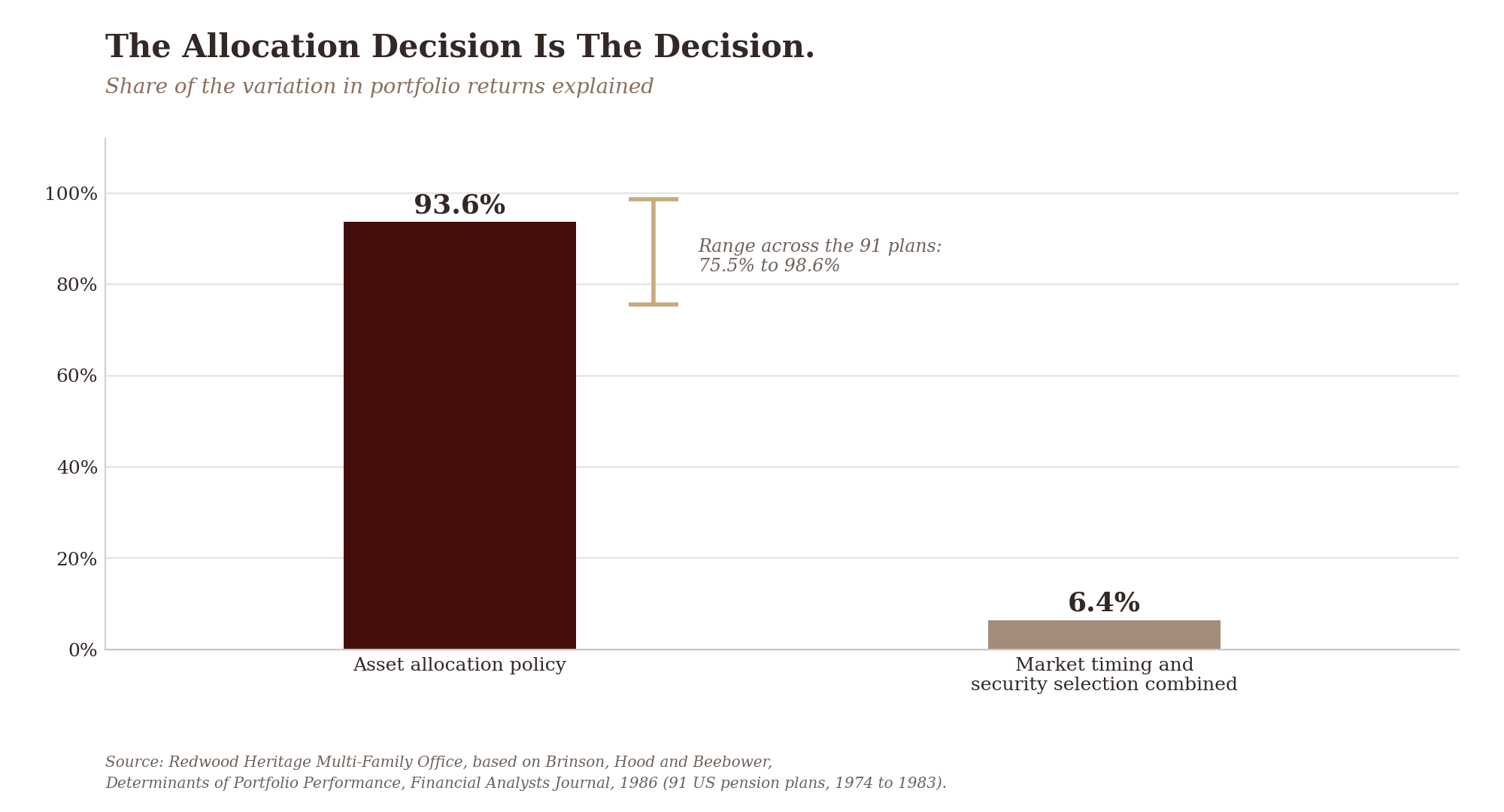
Start with what the evidence says about where portfolio outcomes come from. In 1986 Gary Brinson, Randolph Hood and Gilbert Beebower examined ten years of quarterly returns from 91 large American pension plans and asked a simple question: how much of the movement in a portfolio’s returns is explained by the long-term policy mix, and how much by the skill applied on top of it. The answer was 93.6% from the policy mix. Everything else, the timing of moves between asset classes and the choice of individual securities, accounted for the remainder. Across the individual plans the figure ranged from 75.5% to 98.6%.
That study has been argued over for forty years, and the argument is worth knowing. In 2000 Roger Ibbotson and Paul Kaplan showed that the answer depends entirely on the question. Asked why one portfolio differs from another, policy explains around 40%. Asked why a single portfolio moves over time, around 90%. Asked how much of the level of return it accounts for, close to 100%. The industry picked the number it liked and printed it on a pie chart.
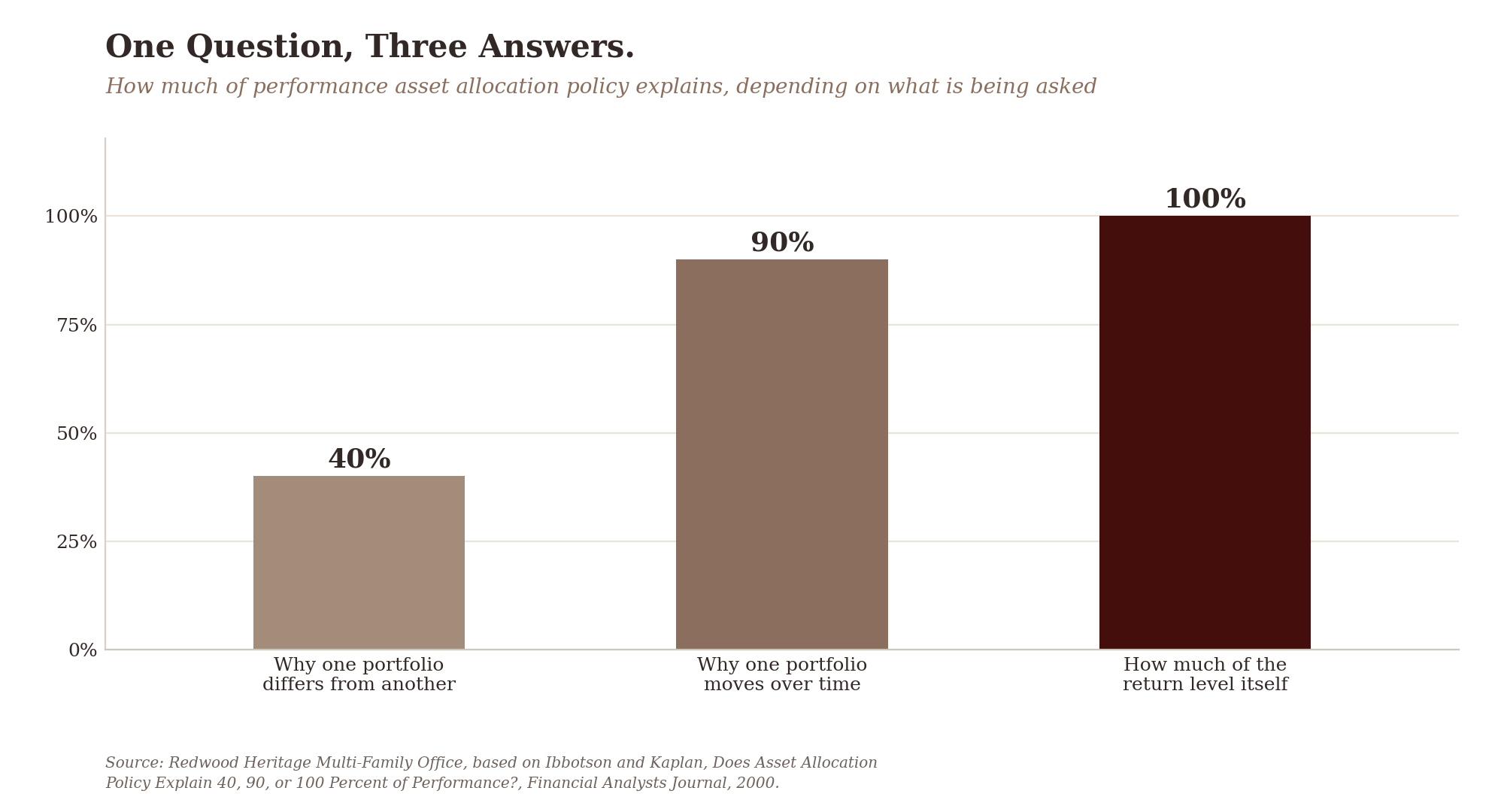
The honest reading is still striking. However the question is framed, the allocation decision dominates everything that follows it. Which makes it remarkable how little time is spent on how that decision is reached, compared with the effort spent on the managers who operate inside it.
What Markowitz Assumed, And Families Do Not Have
The framework almost everyone uses descends from Harry Markowitz’s 1952 work on portfolio selection, which showed how to combine assets to get the most return for a given level of risk. It is one of the most useful ideas in finance and it is not wrong. But it rests on an assumption that is easy to miss. It assumes a single investor, with a single pool of money, one attitude to risk, and no dated obligations. Risk is defined as the variability of returns, not as the chance of failing to meet a specific commitment on a specific date.
A family is none of those things. It is several people with different needs, several pools of money with different purposes, and a calendar of real obligations. Distributions to members who do not work in the business. Tax in more than one country. A fund that will call capital over five years whatever else is happening. A promise to buy out a relative who wants liquidity. A business that may need support in a bad year.
Measured against that calendar, the variability of returns is not the risk. Missing a payment is the risk.
Risk Allocation Before Asset Allocation
This is precisely the gap Ashvin Chhabra identified in 2005, in a paper in the Journal of Wealth Management that remains the clearest statement of the problem. He observed what he called the diversification paradox: wealthy investors are consistently less diversified than the theory says they should be, and this holds across every wealth band. His conclusion was that the framework was measuring the wrong thing. Alongside market risk, a family carries personal risk, meaning the risk of a fall in its standard of living or the loss of what it cannot afford to lose, and aspirational risk, meaning the capital it is willing to put at genuine risk of loss in pursuit of something much larger.
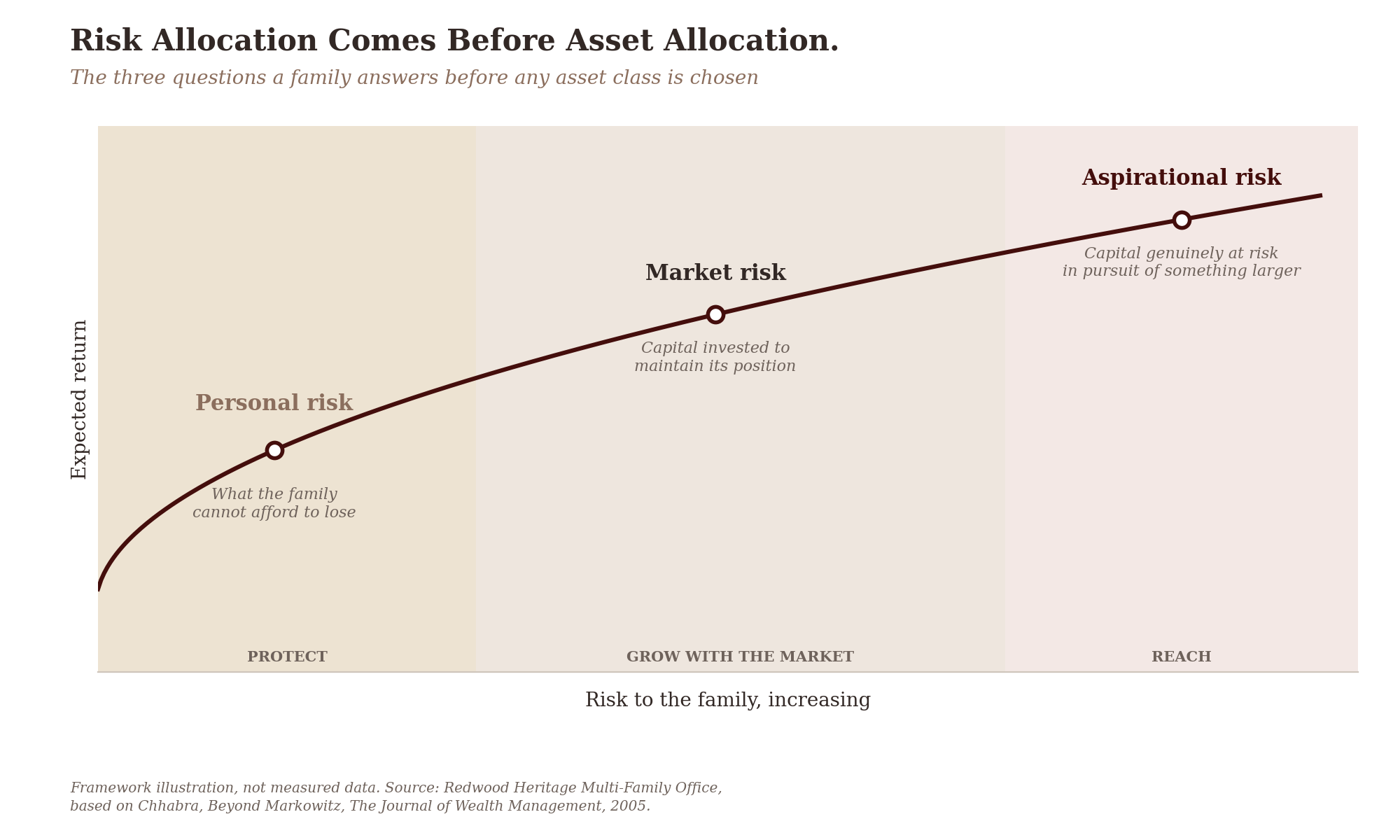
His central conclusion is a single sentence: risk allocation should precede asset allocation. Decide first how much of the capital is protecting the family’s basic security, how much is being invested to maintain its position, and how much is genuinely at risk in pursuit of growth. Those three answers come from the family. Only then does the question of which assets to hold arise, and that question has a technical answer any competent professional can produce.
Risk allocation comes before asset allocation. The first is the family’s work. Only the second can be bought.
This Costs Nothing In Efficiency
The usual objection is that building a portfolio around obligations must be less efficient than optimising the whole pool at once. That objection was settled in 2010, in the Journal of Financial and Quantitative Analysis, by Sanjiv Das, Jonathan Scheid, Meir Statman and Markowitz himself. They showed that a portfolio built as a set of sub-portfolios, each with its own goal, its own threshold and its own tolerance for failing to reach it, aggregates to a portfolio that sits on the efficient frontier. Structuring capital around what it has to achieve does not cost return. The author of the original framework put his name to that finding.
So the argument for designing around the family’s obligations is not a soft one about comfort or behaviour. It is that the optimisation can only be run once someone has specified what is being optimised for, and in most families nobody has. Feed a model a horizon, a liquidity requirement, a currency mix and a limit on lock-ups and it will produce something useful. Feed it nothing and it will produce a representative portfolio for a representative client who does not exist.
What This Means In Practice
None of this argues against external expertise, and we want to be careful here. Market knowledge is genuinely specialised and families are right to buy it. The distinction is what is being bought. A manager, a bank or a consultant can answer how to express a given risk budget efficiently, and can do it better than most families could alone. None of them can say how much risk the family is permitted to take, because that answer lives in the obligations, the authority structure and the tolerance for loss, and those sit inside the family and nowhere else.
The sequence that follows is not complicated. What is this capital for, and over what period. Every known obligation, dated and in the currency it will be paid in, which sets the liquidity and the currency mix before any asset class is discussed. Who may commit capital, to what size and for how long, which sets the ceiling on lock-ups and is a governance answer rather than an investment one. What fall in value would force a sale, and what must never be sold, which sets the defensive core. The market question comes fifth, and by then it is narrow enough to answer well.
Buy the market view. Do not buy the allocation. One is expertise. The other is yours to set.
Conclusion
The families we spoke to this month are not unsophisticated. They employ good people and they ask intelligent questions. The questions were simply arriving in the wrong order, and the order is not a technicality. Forty years of research says the allocation decision dominates the outcome, and the same body of work says that decision cannot be made properly until someone has specified what the money is for.
So before the next allocation review, two questions are worth putting on the table ahead of any discussion of markets. What does this capital have to pay for, to whom, and in which year, written down rather than remembered. And who in this family is permitted to lock money away for a decade, and who has to agree before they do. Until both have answers, any allocation is a guess wearing the clothes of a decision.
A portfolio that beats the market has done well against other portfolios.
A portfolio that meets the family’s obligations has done its job.
The Redwood View is published by Redwood Heritage Multi-Family Office. Architecture. Governance. Stewardship.
Sources
Brinson, G. P., Hood, L. R. and Beebower, G. L. (1986). Determinants of Portfolio Performance. Financial Analysts Journal, 42(4), 39 to 44.
Ibbotson, R. G. and Kaplan, P. D. (2000). Does Asset Allocation Policy Explain 40, 90, or 100 Percent of Performance? Financial Analysts Journal, 56(1), 26 to 33.
Markowitz, H. (1952). Portfolio Selection. The Journal of Finance, 7(1), 77 to 91.
Chhabra, A. B. (2005). Beyond Markowitz: A Comprehensive Wealth Allocation Framework for Individual Investors. The Journal of Wealth Management, 7(4), 8 to 34.
Das, S., Markowitz, H., Scheid, J. and Statman, M. (2010). Portfolio Optimization with Mental Accounts. Journal of Financial and Quantitative Analysis, 45(2), 311 to 334.

