



Artificial intelligence now features in virtually every substantive conversation we hold with the families we advise. The industry continues to frame it as a back-office efficiency tool, something that produces reports faster and processes data more cheaply. The principals and investment committees we work with are asking a more fundamental question. They want to know whether the family office as an institution retains its relevance once a machine can process every manager report overnight, construct a credible asset allocation before the investment committee convenes, and do so at a fraction of the cost of a professional team. The question is legitimate. The answer, however, depends entirely on what the family office is genuinely there to do. Technology can assume the analytical function. It cannot assume accountability to the family, and it cannot earn the trust on which the most consequential decisions depend.
The evidence confirms that families are already operating within this transition, though the extent of adoption varies considerably depending on how the question is framed. A February 2026 study by Ocorian, covering 200 family members and family office executives collectively responsible for $119.4 billion in assets, found that 86% deploy AI somewhere within their operations and data environment. Only 7% are actively seeking to invest in the sector itself, while 74% anticipate increasing their commitment to AI and related technologies within three years. Citi’s 2025 Global Family Office Survey asked a more exacting question, whether AI is actually running operational tasks or investment analysis in practice, and arrived at 22%, up from 13% a year prior. The gap between these figures is not a contradiction. It reflects the difference between using a tool and trusting it with the work that matters
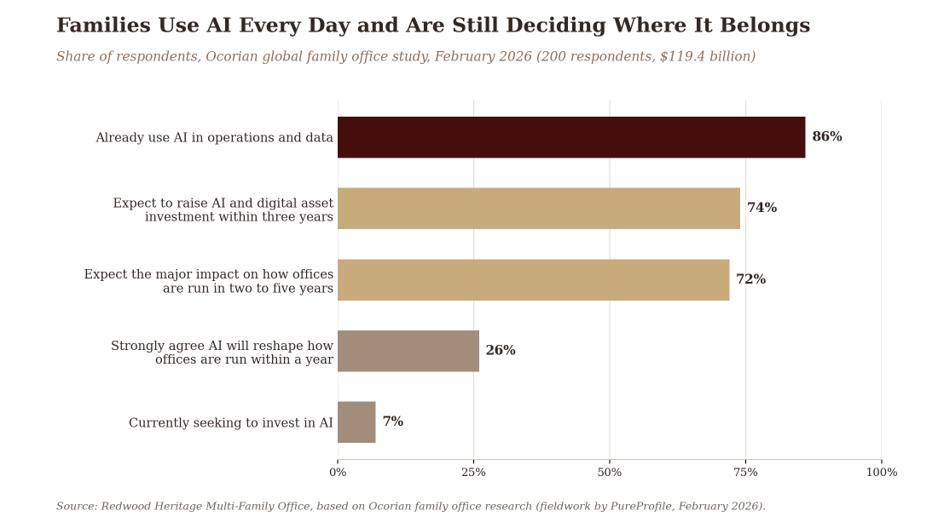
Families are stress-testing what the machine does with their information before permitting it near the decisions that matter.
Fifty Agents Can Already Build a Portfolio
In April 2026, Andrew Ang of Columbia University and co-authors published The Self-Driving Portfolio, describing an agentic architecture of roughly 50 specialised AI agents that set return assumptions, construct portfolios through more than 20 competing methodologies, subject one another’s conclusions to structured critique and vote, and then repeat the process. A supervising agent evaluates each set of forecasts against subsequent outcomes and rewrites the contributing agents to improve their accuracy over time. The system is self-correcting in a way that no human investment team can replicate at the same speed or scale.
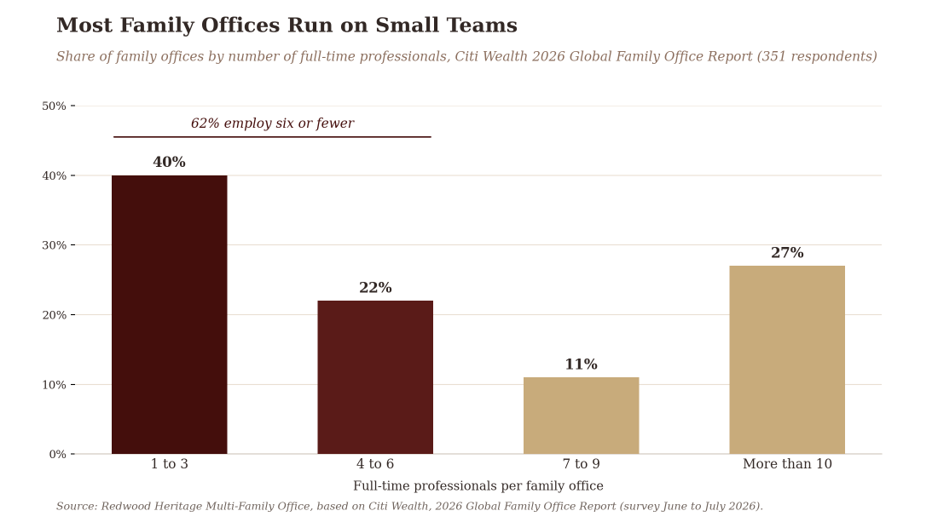
Writing for the CAIA Association this month, Frederic Methlow drew the institutional implication plainly. The traditional investment office, a hierarchy of people passing information upwards toward a chief investment officer and ultimately a board or investment committee, can now be substantially replicated by machines executing that function. For the overwhelming majority of family offices, which operate with lean teams of between one and six professionals, this represents an analytical capacity that was previously inaccessible at their scale.
The Machine Executes the Mandate. It Cannot Establish One.
The Ang architecture operates entirely within the boundaries of an Investment Policy Statement, the governing document that defines what any manager is authorised to do with a family’s capital. The machine executes that mandate with precision and without the capacity to assess whether it remains appropriate to the family’s current circumstances. A system supplied predominantly with private equity marketing material will produce materially different conclusions from one that also incorporates independent analysis of fees, liquidity profiles, vintage year performance and the comparative returns of public-market equivalents. The information the machine is permitted to read determines the conclusions it will reach. That is not a flaw in the technology. It is a governance question that must be answered by a person with clear authority and accountability.
The same limitation applies to historical assumptions embedded in the training data. A model calibrated on the decades preceding 2020 will have absorbed the expectation that inflation would remain sufficiently contained for central banks to ease monetary policy in response to growth shocks. It will apply that assumption to current conditions with considerable confidence, and it will be wrong in ways that may not become apparent until damage has been done. The Investment Policy Statement that governed the portfolio in 2018 may bear little relationship to what the family actually needs in 2026. The machine cannot know that unless someone tells it. And someone must have the authority and the relationship to do so.
Whoever governs what the machine reads governs what the machine concludes.
The Family Is Not a Portfolio
The limitation of AI in the family office context becomes most visible in families that retain ownership of the operating businesses that generated their capital. Citi’s 2026 Global Family Office Report found that 67% of the families surveyed hold controlling stakes in at least one operating company, and approximately one third anticipate a leadership transition within the family, the office or the business within five years. These are not investment decisions in the conventional sense. They are decisions about people, about readiness, about which branch of the family is prepared to carry the responsibility of ownership into the next generation, and how to structure the capital around that transition so that it does not become a source of conflict.
A family’s balance sheet and its governance requirements change every time a founder steps back, a marriage alters the family’s composition, a branch requires liquidity at a pace that the long-term investment strategy did not anticipate, or a succession decision must be made under time pressure. None of that information arrives in a data feed. A model can value the enterprise with considerable precision. It cannot assess whether the designated successor is prepared to lead it. It cannot read the room when two branches of the family reach an impasse over a distribution policy. And it cannot hold the conversation that needs to be held before any of those decisions can be made with clarity.
At Redwood Heritage, our foundational position is that governance defines the asset allocation, not the reverse. As machines become capable of generating twenty credible portfolio constructions in the time it takes to convene an investment committee, what becomes genuinely scarce is something no algorithm produces: a clear, written articulation of what the family is trying to achieve across generations, the constraints within which it is willing to operate, and an authoritative relationship to hold the system accountable to both.
Privacy, Expertise and the Logic of Partnership
Citi’s May 2026 report on AI in the family office addresses the question of trust directly. Privacy, the report concludes, is non-negotiable, and final investment decisions remain with the individuals who carry responsibility for them. A principal shares with a trusted adviser what he would not commit to a system: which heir is not ready to assume leadership, which branch wishes to exit a shared holding, what the family would not want disclosed in any context, and what the real constraints on the capital actually are. That information is the foundation of every allocation decision that matters. It is shared selectively, in private, with someone who has earned the right to receive it over years of careful engagement.
Fifty-seven per cent of family offices identified a lack of in-house expertise as the primary barrier to further technology adoption, according to the same Citi report, and many are responding by turning to specialist external partners rather than attempting to build that capability internally. For a team of three or four professionals, that is a rational and well-considered response. No small office can maintain every specialism that a properly governed investment architecture requires, from manager selection and due diligence to tax structuring, liquidity planning and the oversight of AI systems themselves. Distributing that architecture across several families, each operating under its own confidentiality terms and investment mandate, preserving the independence and bespoke nature of each relationship, is the structural logic of the multi-family office model.
A principal shares with a trusted adviser what he would never entrust to a machine.
Conclusion
The families we serve are already working with AI tools across their operational environments, and that adoption will deepen over the years ahead. The machines can now build, stress-test and critically assess a portfolio without meaningful human intervention. Most family offices are small enough to derive material benefit from that analytical reach. None of this changes who a principal confides in when the decision is genuinely difficult, or who must account to the family when a consequential call proves wrong. Capability scales. Accountability does not automate.
We would encourage investment committees and their advisers to put two questions on the agenda this quarter. First, which decisions taken this year rested on analysis that a machine could now replicate in an afternoon, and which required judgment that a specific person had to own and stand behind? Second, who within the office or advisory relationship determines what information the system is permitted to access, and what the family would never want it to see? Those two questions are not principally about technology. They are about whether the family office, however it is structured and whatever tools it deploys, understands with clarity what it is genuinely there to do.
The answer to that question has always defined the value of the relationship. It still does.
Sources
Ocorian, Family offices turn to AI but avoid investing in the sector for now, 24 March 2026 (research by PureProfile, February 2026).
Citi Wealth, 2026 Global Family Office Report, September 2026.
Citi Institute with Citi Wealth, AI in the Family Office: Privacy, Efficiency and Institutional Rigor, May 2026.
Andrew Ang, Nazym Azimbayev and Andrey Kim, The Self-Driving Portfolio: Agentic Architecture for Institutional Asset Management, SSRN, April 2026.
Frederic J. Methlow, The End of the Family Office as We Know It, CAIA Association, 10 September 2026.

